Personal Loan for Month-End Expenses: Everything You Need to Know (2026 Guide)
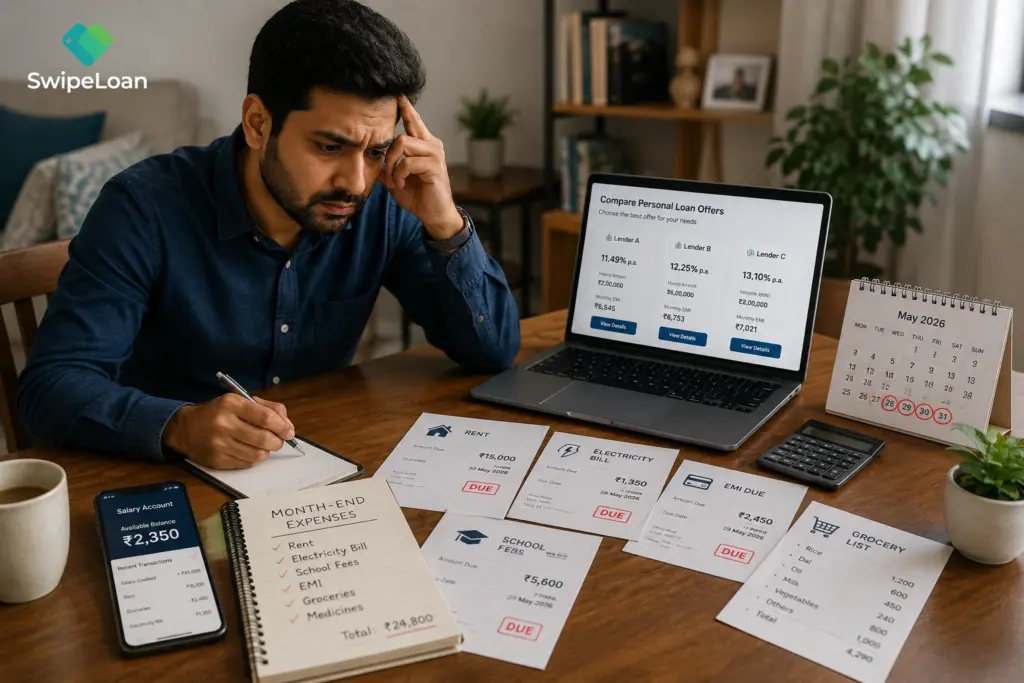
Salaried Indians put more than 33% of their monthly income toward EMIs (Perfios & PwC India, “How India Spends,” via Business Standard, 2025). Add rent, school fees, and household bills that tend to cluster in the same week, and month-end pressure isn’t a budgeting failure — it’s a structural squeeze most salaried households face every single cycle.
A personal loan for month-end expenses is one real answer to that squeeze, but only if you understand what you’re signing up for. This guide covers eligibility, 2026 interest rates, the documents you’ll need, and — importantly — when a personal loan is the wrong tool for a month-end expense and something smaller fits better.
Key Takeaways
- Salaried Indians spend over 33% of monthly income on EMIs (Perfios & PwC India, 2025), which is why month-end cash gaps recur rather than being one-off events.
- In 2026, bank personal loan rates start around 9.99% p.a.; NBFCs, including fintech-led digital lenders, range 10.49%–44% (Paisabazaar / BankBazaar, July 2026).
- A CIBIL score of 750+ unlocks the lowest bank rates; scores of 650–749 can still qualify through NBFCs, often with faster approval.
- For a recurring gap under ₹50,000, a small-ticket loan app may cost and suit you better than a full personal loan — the two products aren’t interchangeable.
- A marketplace like SwipeLoan matches you to 100+ RBI-registered lending partners so you can compare personal loan offers; the lender still sets the rate and disburses the loan.
What Is a Personal Loan for Month-End Expenses?
A personal loan for month-end expenses isn’t a separate loan product — it’s a standard personal loan used for a specific, recurring purpose: bridging the days between when bills land and when your next salary clears. Lenders don’t ask why you need the money for an unsecured personal loan, so the “month-end” framing is about matching the right loan size to a recurring pattern, not a distinct product category.
That distinction matters because two very different tools get marketed for this same pain point. A full personal loan typically starts around ₹50,000 and can run into lakhs, with tenures up to 84 months. A small loan app, by contrast, is built for much smaller, shorter gaps of ₹5,000 to ₹50,000 — we cover how that product works in a companion guide. If your gap is a genuine one-off shortfall under ₹50,000, that product is usually cheaper and faster than applying for a full personal loan.
A personal loan for month-end expenses is simply a standard unsecured personal loan, typically ₹50,000 and above, used to cover a recurring cash gap between salary cycles. It’s distinct from small-ticket “sachet” loan apps, which are built for smaller, shorter-tenure gaps under ₹50,000 (Perfios & PwC India, 2025).
Here’s the pattern worth noticing: if you’re borrowing for the same month-end reason every cycle, a personal loan just delays the problem with interest attached. It’s the right tool for a genuine one-time gap — a large medical bill, a security deposit, a wedding expense that happened to land near month-end — not for permanently patching a budget that runs short every month.
How Much Can You Borrow for Month-End Expenses?
Banks in 2026 sanction personal loans from roughly ₹50,000 up to ₹50 lakh, with tenures stretching up to 84 months (Paisabazaar, Personal Loan Interest Rates, July 2026). The exact amount you’re offered depends on your income, existing EMI load, and credit profile — not a flat ceiling everyone qualifies for.
For a month-end gap specifically, borrowing the full sanctioned amount rarely makes sense. The loan size should match the actual shortfall, not the maximum the lender will offer, since a bigger loan means a bigger EMI added to next month’s obligations.
| Need | Better-fit product | Typical amount | Typical tenure |
|---|---|---|---|
| One-off gap under ₹50,000 | Small loan app | ₹5,000–₹50,000 | Weeks to 12 months |
| Larger one-time expense | Personal loan | ₹50,000–₹5 lakh+ | 1–5 years |
| Recurring monthly shortfall | Neither — budget review | N/A | N/A |
For context on the smaller end of this range, fintech NBFCs sanctioned small-ticket loans at an average size of just ₹9,758 in FY24–25 — a fraction of what a standard personal loan typically covers, and a useful marker for deciding which product actually fits your gap. Before deciding on a size, it’s worth checking how much loan you can safely afford based on your salary.
What Interest Rate Will You Pay in 2026?
Your rate depends heavily on lender type and credit profile. In 2026, bank personal loans start around 9.99% p.a., while NBFCs — a category that includes most fintech-led digital lenders, since they typically operate under an NBFC licence or as an LSP partnering with one — range 10.49%–44% p.a. (Paisabazaar / BankBazaar, July 2026). NBFCs price 2–4 percentage points above banks on average, trading a higher rate for looser eligibility and faster approval.
A 2–3 percentage-point difference sounds small until you run it against a ₹2 lakh loan over 3 years — the gap can add up to tens of thousands of rupees in extra interest. That’s the entire case for comparing offers instead of accepting the first approval.
Are You Eligible for a Personal Loan?
Eligibility comes down to three things: credit score, income stability, and existing debt load. A CIBIL score of 750 or above typically unlocks the lowest bank rates, while scores between 650 and 749 can still qualify — usually through NBFCs, often with same-day approval rather than the best pricing.
Lenders also check your FOIR (Fixed Obligation to Income Ratio) — how much of your income already goes to existing EMIs. If you’re already at 33%+ EMI burden like the average salaried borrower, a new personal loan on top of that can push you into a tighter position rather than solving one. Before applying, it’s worth checking how much loan you can safely afford based on your salary rather than borrowing up to what a lender is willing to offer.
A practical filter we’d recommend: if you’re not sure whether your score clears the bar, check where your credit score stands first. A soft check costs you nothing and doesn’t touch your score, but it tells you which lender tier you’re realistically shopping in before you apply anywhere.
How Do You Apply, and What Documents Do You Need?
The digital process typically needs four things: PAN, Aadhaar-based KYC, recent salary slips or bank statements, and your employment details. Most RBI-registered lenders complete verification and approval digitally, with disbursal in minutes once approval and KYC are done — though actual timing always depends on the lender and your documentation, and no fixed time is guaranteed.
Before you accept any offer, the lender must issue a Key Fact Statement (KFS) disclosing the interest rate, all fees, the APR, and the full repayment schedule — the same RBI-mandated disclosure that applies across personal loans and small-ticket credit alike. If a lender skips this step or pressures you to sign before showing it, treat that as a hard stop.
One more 2025 RBI rule worth knowing before you sign: floating-rate personal loans for individuals can no longer carry foreclosure or prepayment penalties. If your month-end gap turns out to be temporary and you can clear the loan early, see what RBI’s no-prepayment-penalty rule means for your loan before assuming you’ll pay a fee to close it faster.
Personal Loan vs. Small Loan App vs. Credit Card — Which Fits Your Gap?
The right tool depends entirely on the size and nature of the gap, not brand preference. A ₹8,000 shortfall and a ₹2 lakh expense are different problems that call for different products.
| Factor | Personal loan | Small loan app | Credit card |
|---|---|---|---|
| Typical amount | ₹50,000–₹5 lakh+ | ₹5,000–₹50,000 | Existing credit limit |
| Typical cost | 9.99%–44% p.a. | Varies; disclosed in KFS | 30%–45% p.a. if revolved |
| Best for | Large one-time expenses | Small recurring gaps | Short-term float, paid in full |
| Speed | Minutes to a few days | Often fastest | Instant, if limit available |
If you’re weighing this decision every month, that’s a signal worth acting on before it becomes a habit: managing instant personal loan EMIs or reviewing your budget will do more for your finances long-term than any single loan product.
This is where a marketplace helps you compare rather than guess. SwipeLoan is an AI-powered credit-matching loan marketplace and Lending Service Provider under the RBI Digital Lending Guidelines — not a lender. It matches your profile to a network of 100+ RBI-registered lending partners, so you can compare personal loan offers side by side. SwipeLoan doesn’t set your rate, approve your loan, or disburse funds — the partner lender does that, subject to its own credit policy. Checking your eligibility is a soft enquiry, so it doesn’t touch your credit score. Browse all loan products here.
Month-end gap this cycle? Compare personal loan offers before you commit to one.
SwipeLoan is an AI-powered credit-matching loan marketplace and Lending Service Provider — not a lender — that matches you to 100+ RBI-registered partners for personal loan and small-ticket loan offers alike. Final rate, approval, and disbursal always rest with the individual lender; T&Cs apply.
Frequently Asked Questions
Is a personal loan a good idea for month-end expenses?
It depends on the size of the gap. For a large, one-time expense, a personal loan can make sense at 9.99%–44% p.a. depending on lender type (Paisabazaar, July 2026). For a small, recurring shortfall under ₹50,000, a small loan app is usually cheaper and faster.
What CIBIL score do I need for a personal loan in 2026?
A score of 750 or above typically gets you the lowest bank rates. Scores between 650 and 749 can still qualify, usually through NBFCs, though often at a higher rate and with faster approval.
How much can I borrow for a month-end expense?
Banks sanction personal loans from roughly ₹50,000 up to ₹50 lakh in 2026, but the amount you’re actually offered depends on your income, existing EMI load, and credit profile — not a flat ceiling (Paisabazaar, July 2026).
Is a personal loan better than a small loan app for a small gap?
Not usually. Personal loans are built for larger amounts and longer tenures; a small loan app is priced and structured for smaller, shorter gaps. Borrowing a full personal loan for a ₹10,000 shortfall often costs more in fees and commitment than the gap justifies.
Can I prepay a personal loan taken for a month-end expense?
Yes, and often without penalty. RBI’s 2025 rules bar foreclosure and prepayment charges on floating-rate personal loans for individuals, so if your cash flow improves, you can typically close the loan early at no extra cost.
Does SwipeLoan give personal loans directly?
No. SwipeLoan is an AI-powered credit-matching loan marketplace and Lending Service Provider that connects you to RBI-registered banks and NBFCs. The partner lender sets the rate, approves the loan, and disburses funds, subject to its own credit policy and RBI’s rules.
Conclusion
A personal loan can genuinely solve a month-end expense — but only when the expense is a real one-off, not a monthly pattern dressed up as an emergency. Match the loan size to the actual gap: a small loan app for anything under ₹50,000, a full personal loan for larger, one-time needs, and a hard look at your budget if the same gap shows up every cycle.
Whichever route fits, compare more than one lender before you sign. A 2–3 percentage-point rate difference on a personal loan adds up fast, and the only way to catch it is to check offers side by side rather than accepting the first “approved” screen you see.
Compare personal loan offers across 100+ RBI-registered lenders on SwipeLoan →