
RBI Prepayment Charges 2026: No Penalty on Your Loan
The new RBI prepayment charges 2026 rule has quietly handed borrowers a win worth thousands of rupees. If you came into a bonus tomorrow and wanted to clear your floating-rate loan early, your bank can no longer charge you a penalty for doing it. Until this year, the answer was often the opposite.
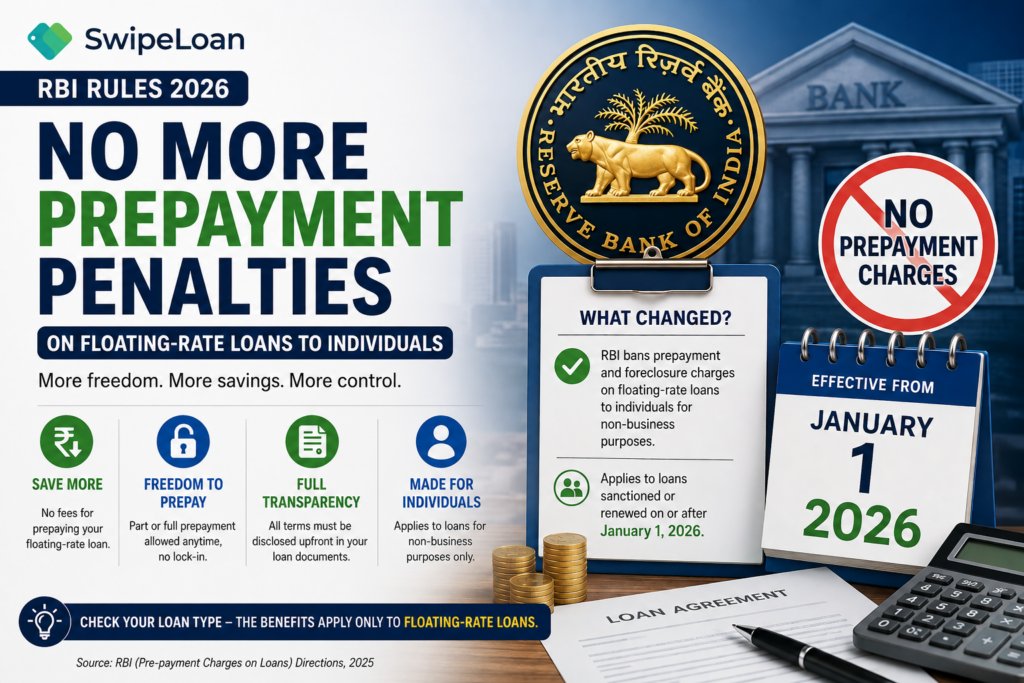
The Reserve Bank of India has scrapped prepayment and foreclosure penalties on floating-rate loans for individuals. This RBI prepayment charges 2026 change took effect on January 1, 2026 — and many borrowers still don’t realise it applies to them. Here’s exactly what changed, who it covers, and the one thing you need to check on your own loan.
Key Takeaways
- Under the RBI (Pre-payment Charges on Loans) Directions, 2025, no lender can levy prepayment or foreclosure charges on floating-rate loans to individuals for non-business purposes (Reserve Bank of India).
- The rule applies to loans sanctioned or renewed on or after January 1, 2026, with no minimum lock-in and regardless of loan amount or source of funds.
- Fixed-rate loans are NOT covered — and many personal loans in India are fixed-rate, so the type of your loan matters more than ever.
- All prepayment terms must now be disclosed upfront in your sanction letter, loan agreement, and Key Fact Statement.
What Exactly Did the RBI Change?
The Reserve Bank of India barred all regulated lenders from charging prepayment or foreclosure penalties on floating-rate loans taken by individuals for non-business purposes, effective for loans sanctioned or renewed on or after January 1, 2026 (Reserve Bank of India, Pre-payment Charges on Loans Directions, 2025). The ban applies whether you repay in part or in full.
In simpler terms: if you have a floating-rate loan and want to clear it early, the lender can no longer punish you with a fee for doing so. That’s a real shift. For years, foreclosure charges of 2% to 5% of the outstanding amount quietly discouraged borrowers from getting out of debt sooner.
The rule is deliberately broad. It applies regardless of the loan amount, regardless of where your repayment money comes from, and without any minimum lock-in period (RBI, 2025). A lender can’t tell you to wait a year before prepaying without penalty anymore.
Why now? The RBI flagged that inconsistent foreclosure practices were trapping borrowers and discouraging healthy repayment. The RBI prepayment charges 2026 ban rewards exactly the behaviour the system should want — people paying off debt when they can afford to.
For the broader picture on how 2026’s rules tilt toward borrowers, see our guide to the RBI’s 2026 digital lending rules.
Who Actually Benefits From the New Rule?
The biggest winners are individuals with floating-rate loans — most commonly home loans, education loans, and certain business loans tied to a benchmark rate. These borrowers can now prepay or foreclose at any time without a penalty, regardless of the amount (Reserve Bank of India, 2025). The relief also extends to Micro and Small Enterprises (MSEs) for many loan categories, broadening the protection well beyond home-loan customers.
Picture a salaried borrower with a floating-rate home loan who receives an annual bonus. Earlier, putting that bonus toward the loan might trigger a foreclosure charge running into thousands. Now, every rupee of that bonus goes straight to cutting the principal — and the interest that rides on it.
The savings compound over a loan’s life. Prepaying early doesn’t just dodge a one-time charge — it removes years of future interest on the amount you clear. Our explainer on how tenure and interest shape your EMI shows why.
The Catch: Does It Cover Your Personal Loan?
Here’s the part most headlines skip. The ban applies only to floating-rate loans. Fixed-rate loans are explicitly excluded, and lenders can still charge prepayment penalties on them as per the agreed terms (Reserve Bank of India, 2025). That single distinction decides whether the rule helps you.
And this is where personal loans get tricky. In India, a large share of personal loans are priced at fixed rates, not floating ones — unlike home loans, which are usually floating. So a borrower celebrating “no more prepayment penalties” may find their fixed-rate personal loan isn’t covered at all. The rule is genuinely powerful, but only if your loan is the right type.
So before you assume you’re protected, do one thing: check whether your loan is fixed or floating.
- Floating rate — Your interest rate moves with a benchmark (like the repo rate). Covered by the new rule for individuals.
- Fixed rate — Your rate stays the same for the whole tenure. Not covered; old prepayment terms can still apply.
Where do you find this? It’s stated in your loan sanction letter, your loan agreement, and your Key Fact Statement. If you’re unsure, that document is the first place to look — not the marketing page.
Disclaimer: Loan terms, rate types, and charges vary by lender and individual agreement. The figures here are illustrative and current as of June 2026. Always read your sanction letter, loan agreement, and Key Fact Statement, and confirm details with your lender before acting. This article is educational and not financial advice.
Why Transparency Is the Quiet Win Here
Beyond scrapping the charge, the RBI tightened disclosure: every prepayment term must now be stated clearly in the sanction letter, loan agreement, and Key Fact Statement, with no retrospective or previously waived charges allowed to reappear at prepayment time (Reserve Bank of India, 2025).
This matters as much as the fee ban itself. The old problem wasn’t only that penalties existed — it was that borrowers often discovered them at the worst possible moment, while trying to close the loan.
According to the RBI’s directions, lenders cannot reinstate a charge they’d previously waived, nor spring an undisclosed fee on you at foreclosure (Reserve Bank of India, 2025). What you’re shown upfront is what you’ll pay — no surprises at the exit door.
For borrowers, the lesson is simple: the Key Fact Statement is becoming the single most important document in any loan. Read it before you sign, and the rules now work firmly in your favour.
How Should Borrowers Use This Change?
Use it to make early repayment part of your plan, not an afterthought. With penalties gone on floating-rate loans, prepaying whenever you have surplus funds is now a clean, cost-free way to cut total interest. The strategy that lenders once discouraged is now fully open to you.
A few practical moves:
- Confirm your rate type — Check your agreement for “fixed” or “floating” before assuming you’re covered.
- Channel windfalls into principal — Bonuses, tax refunds, and maturities can now go straight to your loan with zero penalty.
- Compare before borrowing next time — For a new loan, weigh the rate type, fees, and prepayment terms across lenders, not just the headline interest rate.
Comparing your next loan?
SwipeLoan is a credit-matching loan marketplace — not a lender — that compares your profile across 100+ RBI-registered lending partners. See rates, fees, and terms (including how each loan is priced) in one place, and apply in minutes.
Frequently Asked Questions
When did the RBI prepayment charge ban take effect?
The RBI (Pre-payment Charges on Loans) Directions, 2025 apply to all loans sanctioned or renewed on or after January 1, 2026 (Reserve Bank of India). Loans taken before that date follow their original agreement terms, so the relief is forward-looking rather than retrospective for existing contracts.
Does the ban cover personal loans?
Only if your personal loan carries a floating interest rate. The ban excludes fixed-rate loans, and many personal loans in India are fixed-rate (Reserve Bank of India, 2025). Check your sanction letter or Key Fact Statement to confirm your rate type before assuming you’re covered.
Is there a minimum lock-in before I can prepay penalty-free?
No. For covered floating-rate loans to individuals, the RBI removed any minimum lock-in period, and the relief applies to both part and full prepayment regardless of the source of funds (Reserve Bank of India, 2025). You can prepay whenever you have the money.
Can a lender add a hidden charge when I foreclose?
No. The RBI bars lenders from levying undisclosed, retrospective, or previously waived charges at the time of prepayment (Reserve Bank of India, 2025). All applicable terms must appear upfront in your sanction letter, loan agreement, and Key Fact Statement.
What if my loan is fixed-rate — am I stuck with penalties?
Possibly. Fixed-rate loans are outside the new rule, so lenders can still apply the prepayment charges stated in your agreement (Reserve Bank of India, 2025). Always check those terms before signing, and factor prepayment flexibility into your choice when comparing new loans.
Conclusion
The RBI prepayment charges 2026 ban is one of the most borrower-friendly lending changes in years — but only for those who know whether it applies to them.
- Floating-rate loans to individuals can now be prepaid or foreclosed penalty-free, with no lock-in.
- Fixed-rate loans are excluded, and many personal loans fall in that bucket — so check your rate type.
- Disclosure is mandatory — your Key Fact Statement must spell out every prepayment term.
- Early repayment is now a free strategy for covered loans, cutting both penalties and future interest.
The smartest first step costs nothing: pull out your loan agreement and find out if your rate is fixed or floating. And when you take your next loan, compare the prepayment terms across RBI-registered lenders — not just the interest rate.