IRDAI's Cashless Insurance Rules in 2026: What Happens When the Hospital Still Says No
Does IRDAI’s 1-Hour Cashless Rule Mean You’ll Never Pay Upfront?
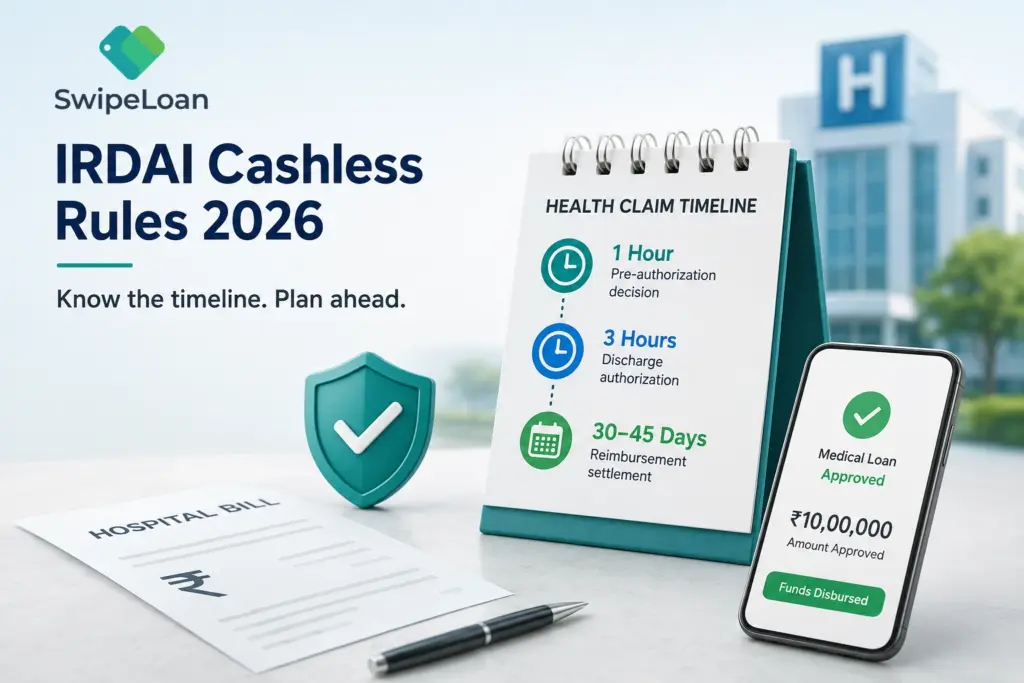
No — not always, and this is the part most coverage of these rules glosses over. IRDAI’s Master Circular on Health Insurance Business does put hard clocks on insurers: a 1-hour decision on cashless pre-authorization, and a 3-hour final sign-off at discharge (Life Insurance International, 2024). But those clocks only start once a hospital agrees to process your claim as cashless in the first place — and not every hospital has to say yes.
What you can count on is a clear, enforceable timeline once a claim is in motion, whether it’s cashless or reimbursement. Knowing exactly what that timeline guarantees — and what it doesn’t — is what actually decides whether you’re covering a hospital bill out of your own pocket while you wait.
Key Takeaways
- IRDAI’s Master Circular on Health Insurance Business (29 May 2024) requires insurers to decide on cashless pre-authorization within 1 hour, and to give final discharge authorization within 3 hours of the hospital’s request (Life Insurance International, 2024).
- If the insurer misses the 3-hour discharge window, it — not you — must bear any extra charges the hospital levies for the delay.
- “Cashless Everywhere,” announced by the General Insurance Council in January 2024, extends cashless treatment to any registered hospital in India — but non-network hospitals can still legally decline it (SMC Insurance, 2026; Corpbiz).
- If cashless is refused, you pay first and claim reimbursement — insurers must settle within 30 days of your complete documents, or 45 days if the claim needs investigation (IRDAI Circular IRDAI/HLT/REG/CIR/152/06/2020).
- Miss that window, and the insurer automatically owes penalty interest at 2% above the RBI’s bank rate — you don’t have to ask for it.
- SwipeLoan is a marketplace, not a lender — we help you compare medical loan offers from RBI-registered lenders so you can cover the bill now, without waiting on your insurer.
What Do IRDAI’s Cashless Rules Actually Guarantee?
Faster decisions, not automatic approval. IRDAI’s Master Circular on Health Insurance Business, issued 29 May 2024, folded 55 older circulars into one rulebook and set firm clocks on cashless claims (Life Insurance International, 2024; Value Added, 2024):
- Pre-authorization: the insurer must decide within 1 hour of the hospital’s cashless request.
- Discharge authorization: the insurer must give final sign-off within 3 hours of the discharge request.
- No waiting at the counter: if the insurer overshoots that 3-hour window, it — not the patient — must cover any extra charges the hospital adds for the delay.
- Insurers had until 31 July 2024 to build the systems to support this.
The same circular also tightened a few other borrower-friendly terms worth knowing when you’re comparing policies: the pre-existing-disease waiting period dropped from 4 years to 3 years on new policies, the age cap on buying a new policy was scrapped entirely, and the free-look cancellation window was extended to 30 days (DD News, 2024).
Does “Cashless Everywhere” Mean Every Hospital Must Accept It?
No — and this is the gap that catches people out. “Cashless Everywhere,” announced by the General Insurance Council in January 2024, was built to let policyholders get cashless treatment at any registered hospital in India, even ones with no formal tie-up to their insurer. It was a real expansion — cashless used to be limited strictly to an insurer’s empanelled network.
Our take: The initiative runs on a discount arrangement agreed between the hospital and insurer at admission, not a legal mandate every hospital must honour. A non-network hospital can still decline — often citing unresolved past dues from insurers, or simply preferring guaranteed upfront cash over negotiating a one-off discount (Corpbiz). If that happens, get the refusal in writing, reference the January 2024 circular, and switch to reimbursement rather than arguing at the desk.
That switch to reimbursement is where the real financial pressure shows up — because even a claim handled exactly by the book isn’t instant.
How Long Can an Insurer Legally Take to Pay a Reimbursement Claim?
Up to 45 days, in some cases. Under IRDAI’s claim-settlement rules — consolidated in Circular IRDAI/HLT/REG/CIR/152/06/2020 and rooted in the IRDA (Protection of Policyholders’ Interests) Regulations, 2017 — insurers must settle or reject a health claim within a set window from the date they receive your last necessary document:
| Claim type | Maximum settlement time | Penalty if missed |
|---|---|---|
| Standard claim, no investigation needed | 30 days | 2% above RBI’s bank rate, paid automatically |
| Claim requiring investigation | 45 days | 2% above RBI’s bank rate, paid automatically |
None of this penalty interest requires a formal claim from you — insurers are required to pay it suo moto, calculated from the date they received your last document to the date they actually pay (TaxGuru, IRDA Protection of Policyholders’ Interests Regulations 2017).
Why 30–45 Days Still Creates a Real Cash Gap
Even a fully compliant insurer, moving well within the rules, can leave you covering a hospital bill for over a month before reimbursement lands. For a planned procedure that’s inconvenient. For an emergency admission with no notice, it can mean dipping into savings meant for something else — or delaying treatment altogether.
How Does a Medical Loan Cover That Gap?
A medical loan is built for exactly the window between “the hospital wants payment now” and “the insurer’s cheque clears in 30–45 days.” Rather than liquidating savings or asking family for an emergency transfer, an unsecured medical loan lets you pay the hospital immediately and repay it on your own schedule — independent of how long the claims process takes.
If you’re admitting a family member and cashless has just been refused, ask the hospital’s billing desk for an itemised estimate before you commit to paying cash. That estimate is exactly what a lender will ask for, and having it ready shaves real time off a medical loan application at the moment you can least spare it.
For an unsecured medical loan of up to ₹10 lakh, covering hospitalisation, surgery, diagnostics, ICU care, medication, and post-hospitalisation costs, lenders typically ask for:
- PAN Card / Aadhaar Card
- Bank statements (last 3–6 months)
- Income proof (salary slip, or ITR/bank statements for the self-employed)
- Hospital estimate, bill, or treatment quotation
Tenures generally run from 3 to 60 months, with the exact rate, amount, and approval left to the individual lender’s credit policy.
This is where a marketplace helps. SwipeLoan is an AI-powered credit-matching loan marketplace and Lending Service Provider under the RBI Digital Lending Guidelines 2022 — not a lender. It matches you to RBI-registered lending partners offering medical loans so you can compare offers in minutes, whether or not you’re waiting on an insurance reimbursement. SwipeLoan doesn’t approve the loan or disburse funds — that’s done by the partner lender, subject to its credit policy. Checking your options is a soft enquiry, so it has no impact on your credit score. See the full medical loan details here or browse all loan products.
Don’t let a claims timeline dictate your treatment.
SwipeLoan is an AI-powered credit-matching loan marketplace and Lending Service Provider — not a lender — that matches you to RBI-registered partners offering medical loans up to ₹10 lakh, so you can compare offers side by side. Final rate, approval, and disbursal always rest with the individual lender; T&Cs apply.
Compare Your Medical Loan Options — Soft Check, No Score Impact →
Frequently Asked Questions
How long does an insurer have to approve cashless treatment?
Under IRDAI’s Master Circular on Health Insurance Business (29 May 2024), insurers must decide on a cashless pre-authorization request within 1 hour, and give final discharge authorization within 3 hours. If the insurer delays beyond 3 hours, it must cover any additional charges the hospital levies for that delay.
Can a hospital refuse cashless treatment under “Cashless Everywhere”?
Yes, in practice. “Cashless Everywhere” extends cashless treatment to hospitals outside an insurer’s network, but it works through a discount arrangement agreed at admission rather than a binding mandate, so a non-network hospital can still decline. If refused, get the refusal in writing and switch to the reimbursement route.
How long can an insurer take to settle a reimbursement claim?
Up to 30 days from your complete documents for a standard claim, or up to 45 days if the claim needs investigation, under IRDAI Circular IRDAI/HLT/REG/CIR/152/06/2020 and the IRDA (Protection of Policyholders’ Interests) Regulations, 2017.
What happens if my insurer takes longer than the allowed time?
The insurer must automatically pay you penalty interest at 2% above the RBI’s bank rate, calculated from the date it received your last necessary document to the date it actually pays. You don’t need to formally request this interest.
Why would I need a medical loan if I already have health insurance?
Because even a fully compliant claim can take 30–45 days to settle, and cashless treatment isn’t guaranteed at every hospital. A medical loan covers that gap so you can pay the hospital immediately rather than waiting on your insurer or dipping into savings.
Does SwipeLoan offer medical loans directly?
No. SwipeLoan is an AI-powered credit-matching loan marketplace and Lending Service Provider that connects you to RBI-registered banks and NBFCs. The partner lender assesses the application, approves the loan, and disburses funds, subject to its credit policy and applicable regulations.
Conclusion
- IRDAI’s 1-hour/3-hour cashless clocks are real and enforceable — but they only apply once a hospital agrees to process the claim as cashless in the first place.
- “Cashless Everywhere” expanded where you can ask for cashless treatment; it didn’t make every hospital’s answer “yes.”
- A reimbursement claim can legally take 30–45 days, with automatic 2%-above-bank-rate penalty interest if the insurer overshoots.
- A medical loan, compared across a few RBI-registered lenders, covers that gap so a claims timeline never becomes the reason care gets delayed.
Compare medical loan offers across RBI-registered lenders on SwipeLoan → — soft check first, no score impact to compare.