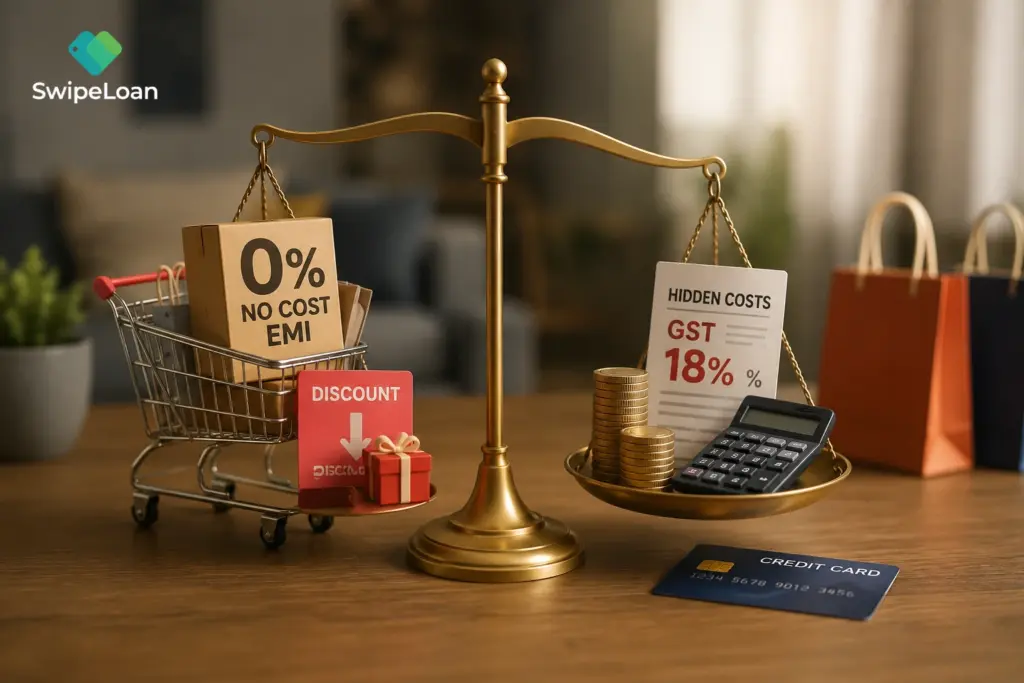
Is 'No Cost EMI' Really Free? The Hidden GST and Discount Trap (2026)
Every festive sale season, “No Cost EMI” flashes across checkout screens on Amazon, Flipkart, and nearly every big retailer in India. It sounds like a genuinely free way to spread out a purchase. It isn’t. The RBI said so in writing over a decade ago.
Are you about to convert a purchase to “no cost” EMI? Two things are worth knowing before you click confirm. First, what you’re actually giving up to get that “zero interest.” Second, a GST charge shows up on your statement no matter how the offer is marketed.
Key Takeaways
- The RBI banned banks from offering true zero-percent-interest EMI schemes in September 2013. It called the “camouflaged” interest — passed off as a processing fee — exploitative to consumers (Business Standard, 2013).
- That 2013 ruling applied only to banks. It didn’t cover NBFCs, which is why “0% EMI” branding is still legal and common today.
- In practice, “no cost” means the retailer gives you a discount equal to the interest amount. You only come out even if you’d have gotten that discount anyway by paying upfront.
- You pay 18% GST on the hidden interest component, and the retailer’s discount doesn’t cover it — it shows up as an extra charge regardless (ClearTax).
- On a ₹30,000 purchase with roughly ₹4,500 in hidden interest, GST alone adds about ₹810. Add any processing fee, and your real cost rises above the sticker price.
- A marketplace like SwipeLoan matches you to 100+ RBI-registered lending partners. You can then compare a small loan or personal loan against what a “no cost” EMI actually costs.
What Does “No Cost EMI” Actually Mean?
It hides the interest rather than removing it. When a retailer advertises “no cost EMI,” the lender — a bank or NBFC — still charges interest on the amount you’re financing. The retailer simply provides an upfront discount equal to that interest, which offsets it on paper. The price you see already has that “discount” baked in, so the EMI schedule looks interest-free.
The RBI explicitly weighed in on this in September 2013. It ruled that true zero-percent-interest EMI schemes don’t exist. Lenders simply reclassify the interest as a processing fee, or absorb it into the price. The RBI directed banks to disclose this transparently rather than market it as free (Business Standard, 2013; Onmanorama, 2023).
Here’s the detail most coverage skips: that 2013 ruling applied specifically to banks. It didn’t cover NBFCs. That’s a large part of why “0% EMI” offers still run legally in India today, through an NBFC partner rather than a bank. The underlying economics work the same way either way — a discount-for-interest swap, with GST on top.
How Does the “Discount for Interest” Swap Actually Work?
The retailer isn’t giving you free financing. It’s giving up a discount it would otherwise offer a cash buyer, and using that forgone amount to cover the lender’s interest. If you were never going to negotiate or claim that discount anyway, the EMI conversion genuinely costs you nothing extra beyond what’s disclosed. But if you would have gotten a lower price by paying upfront, you’ve effectively paid the “interest” — just through a forfeited discount instead of a line-item charge.
A Worked Example
Take a ₹30,000 smartphone financed over a no-cost EMI plan:
| Component | Amount |
|---|---|
| Sticker price | ₹30,000 |
| Hidden interest (absorbed via forfeited discount) | ~₹4,500 |
| 18% GST on that interest component | ~₹810 |
| Bank/NBFC processing fee (typical range) | ₹99–₹500 |
| Minimum real cost | ~₹30,810+ |
On a no-cost EMI purchase, you pay 18% GST on the interest component the lender absorbs. A ₹30,000 purchase with roughly ₹4,500 in hidden interest incurs about ₹810 in GST alone, on top of any processing fee. So the advertised “zero cost” plan still carries a real, disclosed cost (ClearTax).
Is No Cost EMI Ever Actually a Good Deal?
Yes, in one specific situation. That’s when you genuinely weren’t going to get a cash discount anyway, and you’re fine spreading the payment over the GST and processing fee cost. Check the retailer’s “cash price” against the “no cost EMI price.” If they’re identical, there was no discount to forfeit in the first place. The GST and processing fee are then the entire true cost — usually small next to a personal loan or credit card alternative.
A practical way to check this before you commit: ask the retailer, or check the product page, for the straight cash price with no EMI conversion. If it’s meaningfully lower than the “no cost EMI” price, that gap is the interest you’re actually paying — just relabelled. If the two prices are the same, the offer is closer to what it claims to be.
No Cost EMI vs a Personal Loan — Which Actually Costs Less?
It depends on the size of the purchase, and what else you’d use credit for. No-cost EMI suits a single retail purchase with a short tenure — usually 3–12 months — and a small, mostly-disclosed cost: GST plus a modest processing fee. A personal loan makes more sense in three cases: you need cash beyond a single purchase, you want a longer repayment window, or you’re financing multiple expenses at once rather than one checkout item.
Deciding between the two for a specific purchase? Compare the effective cost of the EMI plan — sticker-price discount forfeited, plus GST, plus fee — against a personal loan’s actual quoted APR for the same amount and tenure. Don’t compare the headline “0%” against a loan’s visible interest rate. That comparison isn’t apples to apples.
This is where a marketplace helps. SwipeLoan is an AI-powered credit-matching loan marketplace and Lending Service Provider — not a lender. It matches your profile to RBI-registered lending partners, so you can compare a personal loan quote against what a retailer’s EMI conversion actually costs once GST and fees are factored in. SwipeLoan doesn’t set the rate, approve the loan, or disburse funds — the partner lender does that, subject to its own credit policy. Checking your eligibility is a soft enquiry, so it doesn’t touch your credit score. Browse all loan products here.
Before you convert to “no cost” EMI, see what a real loan quote looks like.
SwipeLoan is an AI-powered credit-matching loan marketplace and Lending Service Provider — not a lender — that matches you to 100+ RBI-registered partners for personal loan offers. Final rate, approval, and disbursal always rest with the individual lender; T&Cs apply.
Frequently Asked Questions
Is no cost EMI really interest-free?
Not quite. The lender still charges interest, but the retailer offsets it with a discount you’d otherwise get for paying cash. If you weren’t going to claim that discount anyway, the plan is close to genuinely low-cost, aside from GST and fees. If you would have claimed it, you’re paying the interest through a forfeited discount instead of a line item.
Why does RBI’s 2013 ban on zero-percent EMI schemes still allow “0% EMI” offers today?
That 2013 ruling applied specifically to banks, not NBFCs. Offers structured through an NBFC partner fall outside that restriction. That’s why “0% EMI” branding remains common, even though the RBI declared true zero-interest schemes non-existent.
Do I pay GST on a no cost EMI purchase?
Yes. An 18% GST applies to the interest component the lender absorbs. The retailer’s discount doesn’t cover this charge — it’s separate. It shows up as an added cost no matter how the plan is marketed.
How do I check if a no cost EMI deal is actually a good one?
Compare the “no cost EMI” price against the straight cash price for the same product. If they’re identical, you’re not forfeiting any discount — your only real costs are the GST and processing fee. If the cash price is noticeably lower, that gap is the hidden interest.
Is a personal loan cheaper than no cost EMI?
It depends on the purchase and tenure. No cost EMI is usually cheap for a single short-tenure purchase, once you account for GST and fees. A personal loan tends to make more sense for larger amounts, longer tenures, or multiple expenses at once. Compare the actual effective cost of each — not the headline “0%” claim.
Does SwipeLoan offer no cost EMI plans directly?
No. SwipeLoan is an AI-powered credit-matching loan marketplace and Lending Service Provider that connects you to RBI-registered banks and NBFCs for personal loans and other credit products. The retailer and its financing partner arrange no-cost EMI plans directly — SwipeLoan isn’t involved.
Conclusion
“No cost EMI” isn’t quite a myth — it’s a mislabelled discount swap with a real, disclosed GST charge attached. The RBI called this out for banks back in 2013. NBFC-backed offers kept the branding alive anyway. The underlying math hasn’t changed: someone still pays the interest, whether it shows up as a line item or a forfeited discount.
Before you tap “convert to EMI” at checkout, check the cash price for the same item. Add up the GST and any processing fee. If the purchase is large enough, compare that real number against a personal loan quote. The label “no cost” is marketing. The actual cost is arithmetic you can do yourself in under a minute.