
Loan Against Mutual Funds in 2026: New RBI LTV Caps, Interest Rates & How Much You Can Borrow
India holds ₹82.22 lakh crore in mutual fund assets across 27.86 crore folios, as of 30 June 2026 (AMFI, June 2026). Yet the default move in a cash crunch is still to redeem units, book tax, and lose the compounding.
A loan against mutual funds avoids all three — you pledge units instead of selling them. In 2026, the RBI rewrote how much lenders may advance against those units, and set a per-person ceiling effective 1 July 2026.
Key Takeaways
- Units are lien-marked, not redeemed — no sale, no capital gains event, no break in compounding.
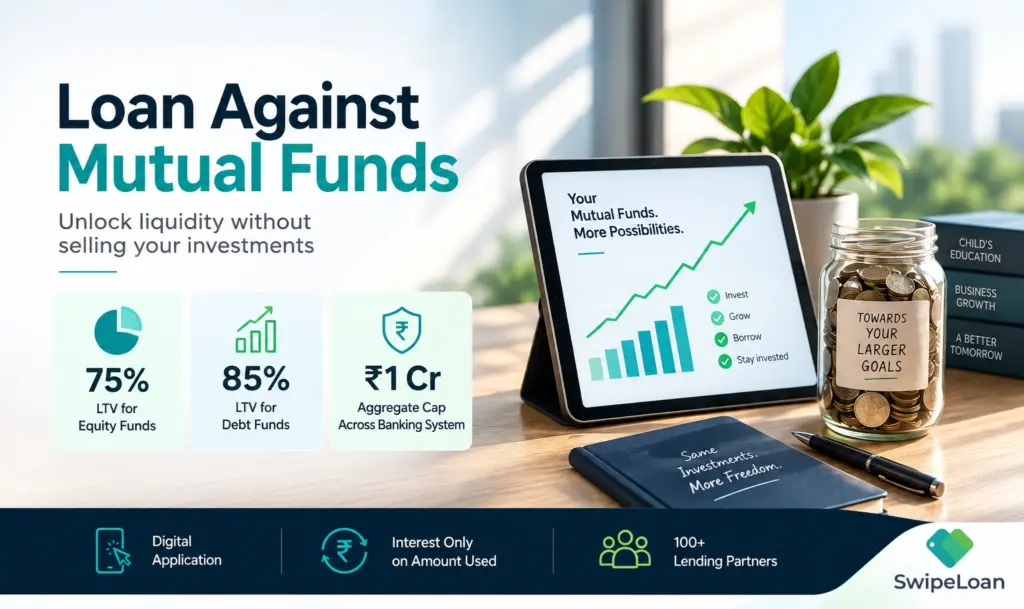
- Under the RBI (Commercial Banks – Credit Facilities) Amendment Directions, 2026, LTV is capped at 75% for equity-oriented funds and 85% for debt-oriented funds (TaxGuru, 30 March 2026).
- Loans against eligible securities are capped at ₹1 crore per individual across the banking system from 1 July 2026.
- Rates run roughly 9%–13% p.a. on equity pledges, and approval leans on collateral value rather than your credit score.
What Is a Loan Against Mutual Funds?
It’s a secured credit facility where you pledge mutual fund units and borrow a percentage of their value — up to 75% for equity funds, 85% for debt funds. Your units stay invested in your name; the lender marks a lien that blocks redemption until you repay.
That’s the whole design. NAV movement and compounding still accrue to you. What you give up is the ability to redeem or switch those units while the lien is live.
How Does a Loan Against Mutual Funds Work?
Through a digital lien with your fund’s Registrar and Transfer Agent — usually CAMS or KFintech, which between them service almost every Indian AMC. The platform fetches your holdings, you choose what to pledge, the RTA marks the lien, and your limit goes live.
Most lenders structure it as a revolving credit line, not a fixed-EMI term loan. You draw what you need and pay interest only on the amount used. Tenure is commonly 12 to 36 months, renewable.
How Much Loan Can You Get Against Mutual Funds?
Pledged value × applicable LTV, subject to the regulatory ceiling. Most lenders apply a stricter internal LTV — often 45%–50% on equity funds — because they carry the volatility risk. Two numbers matter: the regulatory maximum, and your lender’s actual policy.
| Portfolio | Equity (75% cap) | Equity (50% typical) | Debt (85% cap) |
|---|---|---|---|
| ₹1,00,000 | ₹75,000 | ₹50,000 | ₹85,000 |
| ₹5,00,000 | ₹3,75,000 | ₹2,50,000 | ₹4,25,000 |
| ₹10,00,000 | ₹7,50,000 | ₹5,00,000 | ₹8,50,000 |
| ₹25,00,000 | ₹18,75,000 | ₹12,50,000 | ₹21,25,000 |
Loan Against ₹1 Lakh Mutual Funds
Entry level, and it qualifies — most lenders set a minimum pledge value of ₹25,000 to ₹50,000. Watch the fee: a flat ₹999 on a ₹50,000 drawdown is effectively 2%.
Loan Against ₹5 Lakh Mutual Funds
The sweet spot for most retail borrowers — ₹3.75 lakh at the equity cap, or roughly ₹2.5 lakh at a conservative lender LTV.
Loan Against ₹10 Lakh Mutual Funds
Up to ₹7.5 lakh on equity, ₹8.5 lakh on debt. Above this, the ₹1 crore banking-system ceiling starts to bind — it’s an aggregate across all banks, not per lender.
What Is LTV in a Loan Against Mutual Funds?
The ratio of your outstanding loan to the current value of pledged securities. It isn’t fixed at sanction — it moves daily with NAV, and that’s the part borrowers underestimate.
Borrow ₹5 lakh against ₹10 lakh, a comfortable 50%. If the market drops 20%, your collateral is worth ₹8 lakh and your LTV has climbed to 62.5% without you doing anything. Cross the lender’s threshold and you get a top-up call.
The 2026 Directions also value units at the lower of the six-month average NAV and the previous trading day’s NAV (Bankers Club summary). A portfolio that doubled last quarter won’t be valued as though that gain is permanent.
Loan Against Mutual Funds Interest Rate in 2026
Broadly 9% to 13% per annum on equity-fund pledges as of mid-2026, slightly lower on debt funds. Processing fees typically run 0.25% to 1%, though some lenders charge flat.
| Lender | Indicative rate (p.a.) | Minimum |
|---|---|---|
| Mirae Asset Financial Services | From 9.99% – 10.5% | ₹25,000 |
| ICICI Bank | 10.75% – 11.75% | ₹25,000 |
| Bajaj Finserv | 8% – 12% | Varies |
| Volt Money (NBFC-partnered) | 10.49% – 12% | ₹50,000 portfolio |
Indicative rates published by the lenders in 2026. Your actual rate depends on the lender’s credit policy and profile — verify directly before applying.
Why a Lower Rate Doesn’t Always Mean Lower Cost
Here’s what LAMF marketing skips. An interest-only credit line at 10.5% can cost more in rupees than a personal loan at 16% — because an EMI loan retires principal steadily, while a credit line keeps the full amount outstanding until you repay.
So: cheapest when the need is short and lumpy. Stretch it across a full multi-year tenure at full utilisation and the rate advantage erodes.
Loan Against Mutual Funds Eligibility
Eligibility rests on the collateral, not your salary slip — which is why applicants with a modest credit history often still qualify. Typical criteria:
- Resident Indian individual, usually 18+ (some lenders set 21)
- KYC-compliant folio with PAN linked and mobile registered with the RTA
- Minimum portfolio value of roughly ₹25,000 to ₹50,000 in approved schemes
- Units serviced by CAMS or KFintech, for digital lien marking
- Single holding, or joint on an “either or survivor” basis
- A bank account for disbursal, plus a mandate for interest debits
Check your credit score anyway — it still influences the rate you’re quoted, even on a secured facility.
Which Mutual Funds Are Eligible?
Not everything you own. Eligible collateral covers units that are listed or redeemable through the AMC, with underlying equity or debt investments. Beyond that, each lender keeps its own approved list.
Usually accepted: large-cap, flexi-cap, multi-cap and index equity funds from major AMCs; liquid, ultra-short and corporate bond debt funds; hybrid funds at equity LTV; listed ETFs.
Usually excluded: ELSS units inside the three-year lock-in (they can’t be redeemed, so they can’t be collateral), close-ended schemes before maturity, units already pledged elsewhere, and small-cap or thematic funds at some lenders.
Two investors with identical ₹10 lakh portfolios can get very different sanctions purely on scheme mix.
Documents Required
Few, because the RTA already holds the verification trail:
- PAN card — the key for fetching your holdings
- Aadhaar or another accepted KYC document
- Registered mobile and email matching your folio records
- Bank account details plus a NACH or e-mandate authorisation
- Consolidated Account Statement (CAS), usually auto-fetched
Income proof is generally not required for individual pledges.
How to Apply Online for a Digital Loan Against Mutual Funds
Lien marking through CAMS, KFintech or MF Central completes in minutes once consent is given, and lenders commonly disburse the same working day.
- Compare lenders first. Rate, internal LTV, fees and approved scheme lists all vary. Comparing uses a soft check and doesn’t affect your score.
- Enter PAN and registered mobile, verify by OTP. Holdings are pulled from the RTA in seconds.
- Complete OTP-based KYC, typically via Aadhaar or DigiLocker.
- Select schemes to pledge and review the offered limit. Confirm the internal LTV, not just the regulatory cap.
- Link your bank account and set up the e-mandate — the account funds land in, and interest is auto-debited from.
- Authorise the pledge. A separate OTP goes to your folio-registered number; the RTA marks the lien.
- Review the Key Fact Statement and e-sign. The KFS must be shown before you accept, under the RBI Digital Lending Directions, 2025 (Leegality).
- Withdraw funds, in full or in parts.
The order of steps 5 to 7 varies by platform. What doesn’t: the lien is always marked before money moves, and released only on full repayment. Expect three or four OTPs, not one — and the pledge OTP goes to your folio-registered contact, which may not be the number you started with.
Loan Against Mutual Funds Without Selling Your Investments
This is a tax argument as much as an investment one. Pledging isn’t a transfer, so no capital gains arise. Redeeming triggers them: 20% short-term within 12 months, or 12.5% long-term above the ₹1.25 lakh annual exemption beyond it (rates unchanged for FY 2026-27).
Say you need ₹4 lakh and hold ₹10 lakh bought for ₹6 lakh. Selling 40% realises about ₹1.6 lakh of long-term gain — roughly ₹4,375 in tax after the exemption. Modest, but the exemption is now spent for the year and ₹4 lakh has permanently left the market.
That said, if your portfolio is likely to return less than the loan rate, staying invested on borrowed money isn’t automatically smarter.
Loan Against Mutual Funds vs Personal Loan
| Factor | Loan against mutual funds | Personal loan |
|---|---|---|
| Security | Secured — units lien-marked | Unsecured |
| Indicative rate | ~9% – 13% p.a. | Typically higher |
| Amount driver | Portfolio value × LTV | Income and credit score |
| Structure | Revolving credit line | Fixed EMI term loan |
| Interest charged on | Amount drawn | Full principal |
| Market risk | Yes — NAV fall triggers top-up calls | None |
A personal loan is priced against you; a loan against mutual funds is priced against your portfolio. Built the portfolio but have a thin credit file? LAMF is usually the cheaper door. No meaningful holdings, or no appetite for market risk? An instant personal loan is the straightforward option.
Benefits of a Loan Against Mutual Funds
- No capital gains event — nothing is sold, so nothing is taxed
- Compounding continues on the full portfolio
- Interest only on what you draw — an unused limit costs nothing
- Collateral-led approval, useful if your credit history is short
Risks of a Loan Against Mutual Funds
These are real, and they concentrate exactly when markets are ugly.
- Margin calls. An NAV drop that breaches the LTV threshold means repaying part of the loan or pledging more units, typically within days.
- Forced redemption. Don’t cure the shortfall and the lender invokes the lien — crystallising a loss and a tax bill, at the worst price.
- Interest accrues regardless of returns. Your fund might return 6% while the loan costs 11%.
- End-use limits. Loans for acquiring securities in the secondary market are capped at ₹25 lakh per individual.
- The ₹1 crore ceiling applies across the banking system, so an existing facility elsewhere reduces your headroom.
A practical buffer from reviewing lender term sheets: borrow no more than 40%–45% of an equity portfolio’s value, even when offered 75%. That leaves room for a 20% drawdown before you’re near a top-up call.
How to Compare Loan Against Mutual Funds Offers
Look past the advertised rate. Five things move the real cost:
- The internal LTV applied to your schemes — 10% at 45% LTV can lose to 11.5% at 70%
- Fee structure — flat or percentage, on the limit or the drawdown
- Annual maintenance charges on the credit line
- The margin-call trigger and how long you get to cure a shortfall
- Partial-release policy — part-repayment doesn’t automatically free a proportionate chunk of units
A marketplace shows these side by side on a soft check, before a hard inquiry lands on your file. See the loan against mutual funds product or the full product range.
Loan Against Mutual Funds Calculator
Your limit: Pledged value × Applicable LTV — a ₹8 lakh equity portfolio at 50% gives ₹4 lakh; at the 75% ceiling, ₹6 lakh.
Monthly interest: Amount drawn × (Annual rate ÷ 12) — ₹4 lakh at 10.5% costs roughly ₹3,500 a month while outstanding.
Your cushion: 1 − (Current LTV ÷ Trigger LTV) — ₹4 lakh against ₹8 lakh at a 70% trigger means the portfolio can fall about 29% before the call. Borrow ₹6 lakh and that shrinks to roughly 7%.
See what your portfolio can raise — before you redeem anything.
SwipeLoan is an AI-powered credit-matching loan marketplace and Lending Service Provider — not a lender — that matches your profile to 100+ RBI-registered partners so you can compare offers side by side. Final rate, LTV, approval, and disbursal rest with the individual lender; T&Cs apply.
Frequently Asked Questions
How much loan can I get against mutual funds in 2026?
Up to 75% of NAV for equity-oriented funds and 85% for debt-oriented funds, subject to a ₹1 crore ceiling per individual across the banking system from 1 July 2026. Most lenders apply lower internal LTVs, often 45%–50% on equity.
Can I get a loan against mutual funds with a low CIBIL score?
Often yes. Because pledged units secure the loan, lenders weight collateral value more heavily than credit history — the minimum score expectations for unsecured loans don’t apply the same way. Your score still influences the rate.
What happens if my mutual fund value falls after I take the loan?
Your LTV rises. Once it crosses the lender’s trigger you’ll get a margin call to repay part of the loan or pledge more units, usually within days. If you don’t act, the lender can invoke the lien and redeem units.
Do I pay tax when I pledge mutual funds for a loan?
No. Pledging isn’t a transfer, so no capital gains arise. Tax applies only if units are redeemed — including if the lender invokes the lien and sells them, in which case the gain is taxable in your hands.
Does SwipeLoan give loans against mutual funds directly?
No. SwipeLoan is an AI-powered credit-matching loan marketplace and Lending Service Provider connecting you to RBI-registered banks and NBFCs. The partner lender sets the LTV and rate, approves, and disburses under its own credit policy.
Conclusion
A loan against mutual funds solves one problem well: you need cash for a short, defined period and would rather not dismantle a portfolio you spent years building.
What changed in 2026 is precision — 75% on equity, 85% on debt, ₹1 crore per person from 1 July. Borrow well inside those ceilings rather than at them, compare internal LTV and fees rather than the headline rate, and be honest about your repayment horizon.