
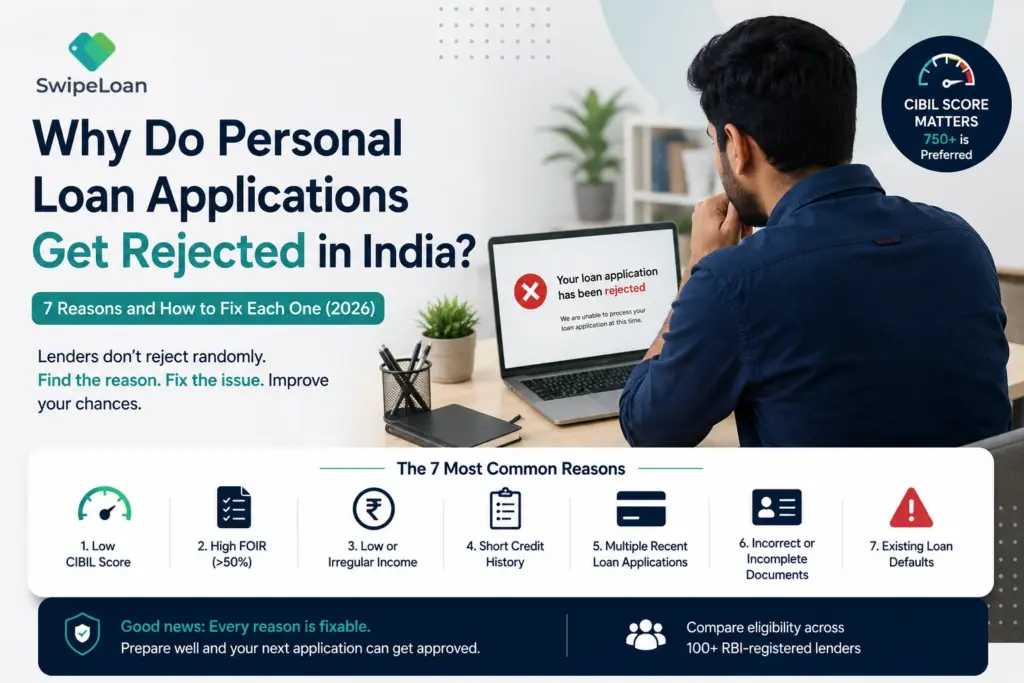
Why Do Personal Loan Applications Get Rejected in India? 7 Reasons and How to Fix Each One (2026)
The message is short and it stings: “We are unable to process your loan application at this time.” No reason. No explanation. Just a no.
Here’s what most borrowers don’t realise: lenders almost never reject you randomly. Behind every rejection is a specific, fixable trigger — a score threshold, an income ratio, a mismatched document. Find the trigger, fix it, and your next application looks completely different.
This guide covers the 7 most common reasons personal loan applications get rejected in India in 2026, exactly how to fix each one, and what to do in the weeks right after a rejection.
Before you reapply anywhere, compare eligibility across 100+ RBI-registered lenders instead of guessing.
Key Takeaways
- Lending has tightened: new retail loan originations grew just 5% year-over-year in March 2025, down from 12% a year earlier (TransUnion CIBIL Credit Market Indicator, 2025).
- The two biggest rejection triggers are a CIBIL score below the lender’s cut-off (many lenders prefer 750+) and a FOIR above ~50% — too much of your income already going to EMIs.
- Each rejection you respond to with another application makes it worse: every formal application adds a hard inquiry to your report.
- Almost every rejection reason is fixable within 3–6 months — the fix depends on identifying the actual trigger first.
Why Are Personal Loans Harder to Get in 2026?
Lenders have genuinely become choosier. In March 2025, new retail loan originations in India grew only 5% year-over-year, down from 12% the previous March, and TransUnion CIBIL’s Credit Market Indicator fell to a two-year low of 97 (TransUnion CIBIL CMI, 2025). Fewer loans are being sanctioned, and the bar to qualify has moved up.
Two forces drove this. First, the RBI raised risk weights on unsecured consumer credit from 100% to 125% in November 2023 (RBI circular, 2023), making every unsecured personal loan more expensive for lenders to keep on their books. Second, that caution worked: personal loan delinquency improved to 1.14% by March 2025, from 1.37% in September 2024 (TransUnion CIBIL, 2025).
The takeaway? A profile that scraped through in 2023 can get declined in 2026. That’s not a verdict on you — it’s a stricter filter you can prepare for.
Reason 1: Is Your CIBIL Score Below the Lender’s Cut-Off?
A low credit score is the single most common rejection trigger. Most lenders prefer a credit score above 750; below 700 often means unfavourable terms, and scores in the 550–650 range risk outright rejection at banks (IDFC FIRST Bank, 2026). On a marketplace, some RBI-registered lenders will consider scores of around 550 or above — but each lender sets its own floor.
The frustrating part is that banks rarely tell you this is why you were declined. You have to check your own report.
How to fix it:
- Pull your credit report first — checking your own score is a soft enquiry with no score impact. A hard enquiry happens only when a lender formally processes an application.
- Bring credit-card utilisation under 30% of your limit.
- Set every EMI and card bill on auto-pay. Payment history is the heaviest factor in your score.
- Give it time: 3–6 months of clean behaviour moves the needle.
Here’s a full walkthrough on how to improve your credit score step by step. And if your score is genuinely low today, see personal loan options for people with a low or zero credit score.
Reason 2: Is Your FOIR Too High? (The Rejection Nobody Sees Coming)
FOIR — Fixed Obligation to Income Ratio — is the share of your monthly income already committed to EMIs and rent-like obligations. Most lenders in 2026 get uncomfortable when a new loan would push FOIR past 50%, and many prefer it under 40% (IDFC FIRST Bank, 2026). This is why borrowers with excellent 750+ scores still get rejected — their income is already spoken for.
A high CIBIL score gets you through the first gate; FOIR decides the second. Lenders read your score as “will this person repay?” and FOIR as “can this person repay one more EMI?” A 780 score with 55% FOIR loses to a 720 score with 30% FOIR at most underwriting desks. Borrowers fixate on the score; underwriters fixate on the ratio.
A quick illustrative example:
| Monthly take-home salary | ₹50,000 |
| Existing EMIs (car + credit card) | ₹18,000 |
| Current FOIR | 36% ✅ comfortable |
| Proposed new EMI | ₹9,000 |
| FOIR after new loan | 54% ❌ likely decline |
How to fix it:
- Close or prepay your smallest loan before applying — even one EMI off the books drops FOIR fast.
- Roll multiple card balances into one payment — here’s how a debt-consolidation personal loan works.
- Ask for a smaller amount or longer tenure, which lowers the proposed EMI.
- Sanity-check yourself before the lender does: how much loan can you safely afford on your salary?
Reason 3: Does Your Income or Job Profile Fall Short?
Every lender runs a minimum-income filter, and it varies by city and employer category. Applications also get declined for job instability — frequent switches, less than 6–12 months in the current role, or salary received in cash rather than a bank credit (Poonawalla Fincorp, 2026). Self-employed applicants without filed ITRs face the same wall.
Lenders aren’t judging your career. They’re asking one question: does verifiable money arrive in this bank account every month?
How to fix it:
- Check the income bar before applying — here’s the minimum salary lenders typically expect for an instant loan.
- Wait until you’ve crossed 6 months in a new job before applying.
- Get salary credited to your bank account, not in cash.
- Self-employed? Bank statements and ITRs can stand in for payslips — see how to get a loan without a salary slip.
Reason 4: Did You Apply to Too Many Lenders at Once?
It feels logical: rejected once, apply to five more. It’s the worst possible move. Every formal application triggers a hard enquiry, and randomly applying to multiple lenders leads to rejection while adding more hard enquiries to your report (IDFC FIRST Bank, 2026). Each lender sees the trail the previous ones left.
That trail reads as distress. Underwriters call it “credit-hungry behaviour,” and it’s a standard decline rule.
Serial loan applications compound rejection risk in India’s credit system. Each formal application places a hard enquiry on the applicant’s bureau report, and lenders explicitly advise checking eligibility and comparing offers before applying to avoid multiple hard enquiries (IDFC FIRST Bank, 2026). Comparing through soft-enquiry pre-checks first avoids leaving this trail entirely.
How to fix it:
- Stop applying for 3–6 months and let the enquiries age.
- Compare first, apply once. On an AI-powered credit-matching loan marketplace, checking which lenders fit your profile uses a soft enquiry — a hard enquiry happens only when a lender formally processes your chosen application.
- If you hold a pre-approved offer, understand what “pre-approved” really means before you accept.
Reason 5: Are There Errors or Old Flags on Your Credit Report?
Sometimes the problem isn’t your behaviour — it’s your report. A loan you repaid showing as overdue, an account that isn’t yours, or an old card closed as “settled” instead of “closed” can all trigger automatic declines. Under the CIBIL dispute process, the lender concerned has 30 days to confirm or correct disputed data (CIBIL, 2026), and most disputes resolve within 30–45 days.
The “settled” flag deserves special mention. Settling a loan for less than the full amount feels like closure, but bureaus record it as a negative marker that lenders read for years. If that’s on your report, read the truth about personal loan settlement in India before your next application.
How to fix it:
- Download your full credit report (not just the score) and read every account line.
- Raise an online dispute with the bureau for any incorrect entry — it’s free.
- If you’ve cleared a previously settled account, ask the lender for a No Objection Certificate and get the status updated to “closed.”
Reason 6: Do Your Documents Tell a Consistent Story?
KYC and document mismatches quietly kill a large share of applications — name spelt differently on PAN and Aadhaar, an address that doesn’t match proof, blurry uploads, or salary slips that don’t reconcile with bank credits (IDFC FIRST Bank, 2026). Digital lenders auto-verify these fields; any mismatch fails silently.
Ten minutes of preparation removes this entire category of rejection. Isn’t that the cheapest fix on this list?
How to fix it:
- Match your name exactly across PAN, Aadhaar, and bank records before applying (update whichever is wrong).
- Upload clear, complete documents — every page, no crops.
- Make sure your current address matches your address proof, or provide a rental agreement.
Reason 7: Is Your Credit File Too Thin to Score?
If you’ve never taken a loan or card, lenders can’t see a repayment history — and many decline what they can’t measure. This “new-to-credit” segment is getting squeezed: the share of NTC consumers supplied with credit fell by three percentage points in early 2025 (TransUnion CIBIL, 2025).
How to fix it:
- Start small: a secured credit card against a fixed deposit builds a file within months.
- Pay two or three billing cycles in full, then apply for the loan.
- Some lenders specialise in first-time borrowers — see loan options when you have zero credit score.
What Should You Do Right After a Rejection?
Don’t reapply the same week — that’s the one move guaranteed to make things worse. Work this sequence instead:
- Ask the lender why. They won’t always tell you, but many share the broad category (score, income, FOIR, documents).
- Pull your own credit report the same day. Soft enquiry, zero score impact.
- Identify your trigger from the seven above. It’s usually obvious once you’re looking at the report and your EMI list side by side.
- Fix the root cause — dispute the error, drop the FOIR, complete the documents, or build the score.
- Wait 3–6 months if the issue was score or enquiries; reapply immediately only if it was a pure document fix.
- Compare before you reapply so your one fresh application goes to a lender whose criteria you actually meet.
Rejection compounds when borrowers treat it as a lottery — reapplying rapidly with the same broken input and collecting hard enquiries with every attempt. Borrowers who diagnose first and apply once convert far better than serial applicants, because the second application is built to pass the specific filter that failed the first.
Match Before You Apply Again
The real lesson of every rejection: the problem is often the pairing, not just the profile. A profile that one bank declines can fit another RBI-registered lender’s criteria the same month.
SwipeLoan is an AI-powered credit-matching loan marketplace — not a lender. It matches your income, score band, and city against the criteria of 100+ RBI-registered lenders and shows you the ones likely to say yes, before any hard enquiry touches your report. You compare real options side by side, then apply once, in minutes, to the lender you choose. Approval, rates, and disbursal always rest with the lender.
Check your loan options across 100+ RBI-registered lenders — compare first, apply once.
Frequently Asked Questions
Why was my personal loan rejected even with a good CIBIL score?
Usually FOIR. If existing EMIs plus the proposed EMI cross roughly 50% of your monthly income, lenders often decline regardless of score (IDFC FIRST Bank, 2026). Job stability, employer category, and document mismatches are the other score-independent triggers.
Does a loan rejection itself reduce my CIBIL score?
No — the rejection isn’t recorded on your report. What affects your score is the hard enquiry made when the lender processed your application. Several hard enquiries in a short window compound the dip, which is why serial reapplying after a rejection backfires.
How long should I wait before reapplying after a rejection?
If the trigger was your score or multiple enquiries, wait 3–6 months while you fix the root cause. If it was purely a document or KYC error, you can reapply as soon as it’s corrected. Always confirm the reason before reapplying anywhere.
Can I get a personal loan after rejection if my score is low?
Possibly — cut-offs vary by lender. Some RBI-registered lenders on marketplaces consider scores of around 550 or above, though amounts and rates reflect the risk. Improving the score for 3–6 months first widens your options considerably and lowers the rate you’re offered.
Does checking my eligibility on a loan marketplace hurt my score?
No. Eligibility checks on a marketplace use a soft enquiry, which is invisible to lenders and has zero score impact. A hard enquiry is recorded only when a lender formally processes the application you choose to submit.
Conclusion
- Rejections in 2026 are mostly stricter filters, not personal verdicts — origination growth has slowed to 5% and lenders screen harder.
- Diagnose your specific trigger: score, FOIR, income stability, enquiry pile-up, report errors, documents, or a thin file.
- Never respond to a rejection with a burst of new applications — every one adds a hard enquiry.
- Fix the root cause, wait it out where needed, then compare lenders before your single next application.
One rejection is feedback. Use it, fix the trigger, and make the next application the one that fits.
Compare your options across 100+ RBI-registered lenders on SwipeLoan — soft check first, no score impact to compare.