CIBIL Score for Personal Loan: Minimum Required in 2026
Getting a personal loan rejected because of your CIBIL score is one of the more frustrating financial experiences — especially when no one tells you exactly why. In most cases, the answer is a three-digit number sitting inside a bureau report you’ve never read.
In India, your CIBIL score determines whether lenders approve your loan in seconds or send a polite decline. It shapes your interest rate, your loan amount limit, and in some cases whether you can access credit at all. But the rules aren’t uniform — and knowing exactly which score unlocks which lender is the difference between getting funded fast and spending weeks getting rejected.
This guide breaks down the minimum CIBIL score required for personal loans in 2026 by lender type, what your options are if your score falls short, and the fastest paths to improvement.
Compare personal loan options across 100+ lenders →
Key Takeaways
- A CIBIL score of 750 or above is required by most Indian banks and gives access to the lowest interest rates (TransUnion CIBIL, Score Classification Guide, 2024).
- Scores between 650 and 749 can still qualify through NBFCs and loan marketplaces — often with same-day disbursal.
- Payment history is the single highest-weighted factor in your CIBIL score; clearing dues and reducing credit card utilisation below 30% are the two fastest levers for improvement.
What Is the Minimum CIBIL Score Required for a Personal Loan in 2026?
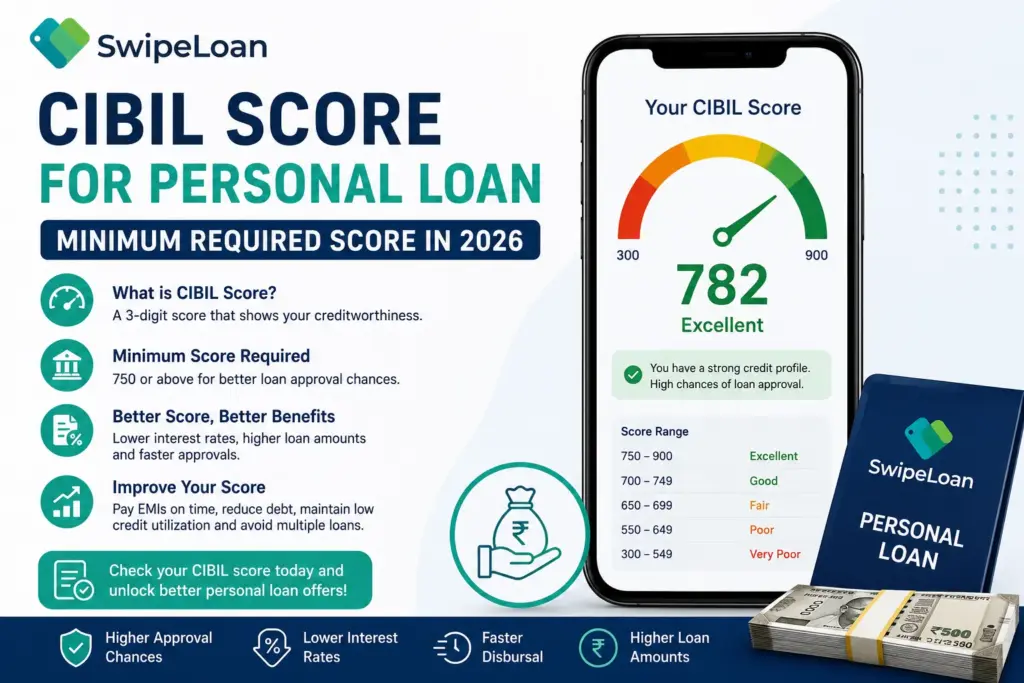
In 2026, the standard minimum CIBIL score for personal loan approval at Indian banks is 750, though scores as low as 650 remain viable through NBFCs and digital lenders. TransUnion CIBIL — India’s oldest and most widely used credit bureau — classifies its 300–900 score scale into five bands, with 750–900 designated as “Good,” the threshold where lenders compete for your business rather than debate your risk profile (TransUnion CIBIL, CIBIL Score and Report Guide, 2024).
Indeed, the 750 benchmark reflects a statistical reality in Indian lending: borrowers in this band demonstrate significantly lower default rates, which is why banks reserve their lowest interest rates for this cohort.
Here’s how score bands translate to real loan outcomes:
| CIBIL Score Band | Classification | What to Expect |
|---|---|---|
| 750 – 900 | Good / Excellent | High approval rate; best interest rates from banks and NBFCs |
| 700 – 749 | Fair to Good | Approval possible at most lenders; rates may be 1–3% higher |
| 650 – 699 | Average | NBFCs and loan marketplaces are primary options |
| 600 – 649 | Poor | Limited unsecured options; secured loan or co-applicant advisable |
| 300 – 599 | Very Poor | Most lenders decline; focus on credit rebuilding first |
According to TransUnion CIBIL’s Score Classification Guide (2024), India’s credit score scale runs from 300 to 900. Borrowers at or above 750 are classified in the “Good” band, a threshold that correlates directly with higher approval rates and preferential interest rates across both public sector and private sector banks. The 750 marker remains the practical minimum for mainstream unsecured personal loan access in India in 2026.
Check if you qualify right now — free eligibility check →
How Do Different Lenders Set Their CIBIL Score Cutoffs?
Not every lender uses the same score threshold — and this variation is exactly where loan marketplaces create genuine value for borrowers. In 2026, public sector banks are the strictest, private banks sit in the middle tier, and NBFCs along with FinTech lenders routinely approve borrowers in the 650–700 range (Reserve Bank of India, Report on Trend and Progress of Banking in India 2024–25, 2025).
Here’s what the full lender spectrum actually looks like:
PSU Banks — SBI, PNB, Bank of Baroda
- Minimum CIBIL: 700–750 (SBI officially states 700+ for most personal loan products)
- Interest rates: 10.50%–14% p.a.
- Processing time: 5–7 working days
- Best for: Stable salaried employees with an existing banking relationship
Private Banks — HDFC, ICICI, Axis, Kotak
- Minimum CIBIL: 700–750, with 750+ preferred for best-rate tiers
- Interest rates: 10.50%–21% p.a.
- Processing time: 2–5 working days
- Best for: Urban salaried professionals at listed companies
NBFCs — Bajaj Finance, Tata Capital, Fullerton India
- Minimum CIBIL: 650–700
- Interest rates: 13%–26% p.a.
- Processing time: 24–72 hours
- Best for: Self-employed borrowers, recent salary hikes, irregular income profiles
FinTech / Instant Lenders — KreditBee, Fibe, MoneyTap
- Minimum CIBIL: 600–650 (some supplement bureau scores with UPI and banking data)
- Interest rates: 18%–36% p.a.
- Processing time: Minutes to hours
- Best for: Young borrowers, thin-file applicants, small-ticket credit needs
Loan Marketplaces — SwipeLoan
- Score requirement: No single cutoff; your profile is matched simultaneously across 100+ lenders
- Interest rates: From 10.50% p.a. depending on the matched lender
- Processing time: Instant match; same-day disbursal possible
- Best for: Any credit profile — the algorithm finds the best available offer without multiple hard inquiries damaging your score
Compare all lender rates side by side →
Can You Get a Personal Loan with a CIBIL Score Below 700?
Yes — and in fact, it’s far more common in 2026 than most borrowers assume. India’s NBFC and FinTech sector has developed alternative underwriting frameworks that look beyond the bureau score alone, incorporating employment type, income stability, banking transaction patterns, and UPI behaviour (Reserve Bank of India, Financial Stability Report, June 2025). The result: real approval pathways for borrowers in the 600–749 band.
Specifically, here is what you can realistically expect at each sub-700 level:
Score 700–749: Most NBFCs approve at near-standard terms. A few private banks will approve with a 1–3% rate premium above their best tier. Loan amounts are typically capped at ₹5–10 lakh without additional income documentation.
Score 650–699: NBFCs and FinTech lenders are your primary channel. Interest rates generally fall in the 15%–24% range. Approval is heavily influenced by your income category — a salaried employee at a listed employer has meaningfully better odds than a self-employed applicant at this score level.
Score 600–649: Instant FinTech lenders and select NBFCs offer small-ticket loans (₹10,000–₹1 lakh). Alternatively, a secured product — loan against FD, gold loan, or loan against property — bypasses the unsecured CIBIL floor entirely and gives you access at much lower rates.
What actually matters alongside your score:
- Monthly income: Higher income compensates for a lower CIBIL score in lenders’ FOIR (Fixed Obligation to Income Ratio) calculations
- Employment type: Salaried employees at listed companies score better than informal self-employment profiles
- Existing debt obligations: Low FOIR — generally below 50% — significantly improves approval odds
- Bank statement quality: 3–6 months of consistent salary credits signal repayment reliability even when the bureau score is mid-range
In India’s evolving credit market, a CIBIL score below 700 is not a permanent disqualifier for personal loans. NBFCs and digital lenders regulated by the Reserve Bank of India have developed risk frameworks incorporating income data, employment tenure, and banking behaviour alongside bureau scores — creating legitimate approval pathways for borrowers in the 600–749 band, particularly for loans up to ₹5 lakh.
Not sure if you qualify? Don’t guess — and don’t risk hard inquiries.
SwipeLoan matches your profile across 100+ RBI-registered lenders in seconds. One application, zero CIBIL impact, instant eligibility result.
Apply for a personal loan for low CIBIL score →
What 5 Factors Actually Determine Your CIBIL Score?
Understanding what builds — or silently damages — your CIBIL score is the prerequisite to improving it. In 2026, TransUnion CIBIL uses five primary factors in its score calculation, with payment history carrying the highest approximate weight at around 35% of the total score (TransUnion CIBIL, Understanding Your CIBIL Score, 2024).
1. Payment History (~35% of Score)
Every EMI paid on time contributes positively; every missed or delayed payment erodes it. For example, a single 30-day default can drop a 750 score by 50–100 points. As a result, this is the factor with the highest leverage — and the highest downside risk. Therefore, consistent on-time payment for 12+ months is the most reliable path to a meaningful score recovery.
2. Credit Utilisation Ratio (~30% of Score)
This measures what percentage of your available revolving credit you’re actually using. If your combined credit card limit is ₹2 lakh and your balance is ₹1.8 lakh, your utilisation is 90% — a significant negative signal. Keeping utilisation below 30% of your total limit is the single fastest lever for score improvement, since it resets at each monthly bureau update cycle.
3. Credit History Length (~15% of Score)
How long your oldest active account has been open matters more than most people realise. For instance, a borrower with a 10-year-old credit card and clean history will outscore someone with identical payment behaviour but a 2-year history. Consequently, don’t close old credit cards — even dormant ones anchor your history length.
4. Credit Mix (~10% of Score)
Similarly, a healthy mix of secured loans (home loan, car loan) and unsecured credit (personal loan, credit card) signals well-rounded credit management. In contrast, over-reliance on a single product type — particularly only unsecured — can limit your score ceiling over time.
5. New Credit Inquiries (~10% of Score)
Finally, each time you apply for new credit, the lender initiates a “hard inquiry” on your bureau report. Each hard inquiry typically dips your score by 5–15 points and remains on record for 24 months. As a result, applying to multiple lenders directly in a short window stacks these penalties — which is why a single marketplace application protects your score during loan shopping.
Check your CIBIL score free — no hard inquiry →
How to Improve Your CIBIL Score Before Applying for a Personal Loan
Most score improvement strategies take 3–6 months to show meaningful results. However, a few targeted actions can shift your score within 30–60 days. Moreover, with CIBIL updating scores monthly, consistent action compounds quickly (TransUnion CIBIL, Credit Health Report, 2024).
30-Day Actions (Fast Impact)
Pay down credit card balances first. Dropping utilisation from above 50% to below 30% can add 20–50 points at the next monthly update — the single highest-ROI action available to most borrowers.
Clear overdue EMIs immediately. Even one overdue account shifting from “DPD 30” to “Current” improves your payment history profile. The delinquency notation remains on record for 36 months, but its negative weight diminishes as the account ages into good standing.
Dispute CIBIL errors. Under the Reserve Bank of India’s consumer credit rights framework, you’re entitled to dispute inaccuracies on your report free of charge. Errors — closed accounts marked active, wrong personal details, or accounts opened fraudulently — can suppress your score by 50–200 points without your knowledge. Check your free annual CIBIL report from the official CIBIL website.
60–90 Day Improvements
Stop all new loan and credit card applications. A 60–90 day pause on new credit applications stops fresh hard inquiries from accumulating and gives your score breathing room to recover.
Pay more than the EMI minimum. Additional principal payments reduce your outstanding balance and improve your FOIR — both of which improve your profile for lenders who look beyond the bureau score.
Become a co-applicant on a family member’s account. If a parent or spouse with an excellent credit history adds you as a co-applicant on an existing loan, their positive repayment behaviour partially reflects on your credit file.
6-Month Credit Rebuild
Apply for a secured credit card against an FD. This gives you a credit line you control entirely. Use it for small purchases and pay the full balance monthly — clean payment history builds predictably, and since it’s secured, the lender can’t adjust your limit unexpectedly.
Keep salary credits consistent in your primary bank account. NBFCs and loan marketplaces weight 3–6 months of clean salary inflows heavily when assessing borrowers in the 650–750 score band. Your bank account is a parallel data source that can compensate for a mid-range bureau score.
Apply for an instant loan once your score improves →
Frequently Asked Questions
What is the minimum CIBIL score required for a personal loan in India in 2026?
Most PSU and private banks require a minimum CIBIL score of 700–750 for personal loan approval in 2026, with 750 being the preferred threshold for best-rate access. NBFCs and digital lenders accept scores from 650 onwards. Loan marketplaces like SwipeLoan match your profile across 100+ lenders simultaneously, finding options for scores as low as 600 in some cases.
Does checking my CIBIL score affect it?
No. Checking your own CIBIL score is a “soft inquiry” with zero impact on your score. Only hard inquiries — initiated by lenders when you apply for credit — temporarily lower your score. The Reserve Bank of India entitles every borrower to one free credit report per year from each of India’s four licensed credit bureaus: TransUnion CIBIL, Equifax, Experian, and CRIF High Mark.
Check your score for free — no CIBIL impact →
Can I get a personal loan with a 650 CIBIL score in India?
Yes. NBFCs, FinTech lenders, and loan marketplaces actively approve borrowers in the 600–699 score range in 2026. Loan amounts are generally capped at ₹5 lakh, and interest rates are higher — typically 15%–26% p.a. Strong income documentation, stable employment at a recognised employer, and clean bank statements significantly improve your approval odds at this score level.
How long does it take to improve a CIBIL score from 650 to 750?
With consistent action — reducing credit card utilisation below 30%, clearing any overdue accounts, and pausing new credit applications — most borrowers can gain 50–80 points within 3–6 months. Since CIBIL updates scores monthly, improvements in utilisation and payment status reflect quickly. Disputing and resolving report errors can accelerate this timeline significantly.
What is the difference between CIBIL score and credit score in India?
“CIBIL score” refers specifically to the credit score generated by TransUnion CIBIL, India’s oldest and most widely used credit bureau. “Credit score” is the broader term — India has four RBI-licensed credit bureaus, each generating its own score using similar but not identical methodologies. Because most Indian lenders primarily pull TransUnion CIBIL data, the terms are used interchangeably in practice. Your scores across bureaus may differ slightly.
Personal loan options for low CIBIL score applicants →
Conclusion
Your CIBIL score is the most important single number in your personal loan application — but it isn’t fixed, and it isn’t your only option. In 2026, a score of 750 or above opens the best rates across banks. Scores between 650 and 749 still get loans approved through NBFCs and marketplaces. And if you’re below 650, the combination of targeted credit actions and the right lender channel can still move you forward.
Therefore, the smarter path is knowing exactly where you stand before you apply, choosing the right lender type for your current score, and not wasting hard inquiries on lenders whose minimum you don’t yet meet.
Three things to do today:
- Check your free CIBIL score to establish your baseline
- If below 750, identify your highest-impact improvement action (usually credit card utilisation)
- Use a loan marketplace to match against 100+ lenders without damaging your score further
Start your loan application — zero CIBIL impact →