
Loan Apps in India: How to Compare Options Before Applying
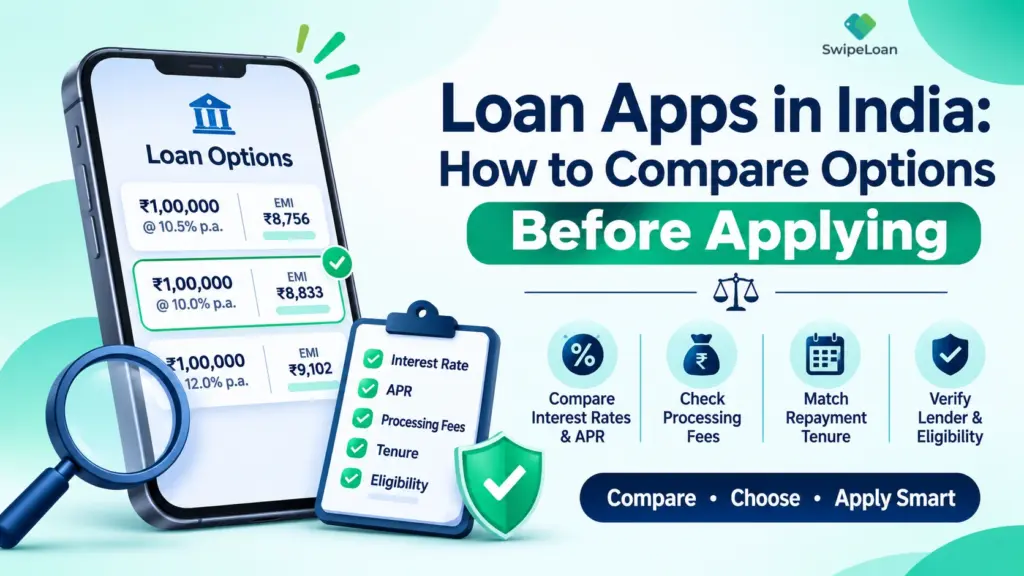
Loan Apps in India: How to Compare Options Before Applying
Choosing a loan app in India is no longer just about finding an application that offers quick access to money. With digital lending platforms connecting borrowers with different banks and NBFCs, applicants have more ways to explore loan options. But more choices also mean more terms, charges and eligibility conditions to understand.
A loan app advertising a low interest rate may not necessarily offer the lowest overall borrowing cost. Processing fees, repayment tenure, applicable charges and lender-specific eligibility criteria can make a significant difference.
The bigger question is not simply which loan app offers the highest amount or fastest processing. It is which available option matches your financial requirements and repayment capacity.
Before submitting a loan application, it is worth understanding how online loan apps work, what separates a lending application from a loan marketplace, and which factors deserve attention when comparing offers.
Key Takeaways
- Compare the APR and total repayment amount instead of looking only at advertised interest rates.
- Verify whether the loan is provided by an RBI-regulated bank or NBFC.
- Understand the difference between a direct lending app and a Lending Service Provider (LSP).
- Check processing fees, repayment tenure, EMI and other applicable charges.
- Review the Key Fact Statement (KFS) before accepting a loan.
- Check your eligibility and credit profile before submitting formal applications.
- Understand how your personal and financial information will be collected and used.
What Are Loan Apps and How Do They Work?
Loan apps are digital applications that allow individuals to explore, apply for or manage loan products through mobile phones and web platforms.
These applications can be operated by banks, Non-Banking Financial Companies (NBFCs), or Lending Service Providers working with regulated lending institutions.
Depending on their operating model, loan apps may facilitate the complete digital lending journey or help borrowers discover suitable lending options.
A typical digital loan application process involves:
- Registration: Enter basic personal and contact information.
- Profile assessment: Provide details about income, employment and existing financial obligations.
- Credit assessment: The lending institution evaluates the applicant’s credit profile and repayment capacity.
- Offer discovery: Available loan options may be presented based on the applicant’s profile and lender policies.
- Verification: Complete the required KYC and document verification.
- Loan agreement: Review the applicable interest rate, APR, fees, repayment schedule and loan conditions.
- Disbursal: After approval and acceptance, the lending institution disburses the loan according to the agreed terms.
The exact process can differ between applications and lending institutions.
An important point is that a loan app does not always provide the loan itself. Some applications are digital interfaces operated by regulated lenders, while others facilitate loan discovery and application through an LSP arrangement.
Types of Loan Apps Available in India
Not every loan app serves the same purpose. Understanding the different types can help borrowers identify which platform is relevant to their requirements.
1. Bank and NBFC Loan Apps
These applications are operated by banks or NBFCs that provide lending services directly. Borrowers can explore the institution’s loan products, check eligibility, submit applications and manage repayments through its digital platform.
2. Instant Personal Loan Apps
Instant personal loan applications generally focus on unsecured borrowing for personal financial requirements. Depending on the lender, borrowers may be able to apply for expenses such as medical bills, education, household requirements or unexpected financial needs.
However, advertised processing speed does not guarantee approval or immediate disbursal.
3. Loan Comparison and Marketplace Platforms
These platforms help borrowers discover and compare potentially suitable loan options from multiple lending partners.
Instead of relying on one lender’s products, applicants can explore options based on their financial profile and eligibility.
An LSP may facilitate customer acquisition, eligibility assessment support and loan discovery, while the regulated lending partner retains responsibility for the lending decision.
4. Secured Loan Applications
Some digital platforms facilitate loans against assets such as property, securities or eligible mutual fund investments.
Because these loans involve collateral, the lender evaluates both the borrower’s profile and the value and eligibility of the pledged asset.
Why Should You Compare Loan Apps Before Applying?
Choosing the first loan app that appears in a search result may limit your understanding of other available options.
Different lending institutions have different credit policies, interest rates, fees and repayment conditions. Comparing these factors can help you make a more informed decision.
Understand the Actual Cost of Borrowing
A low advertised interest rate does not necessarily mean a loan is inexpensive. The total borrowing cost may include processing fees, applicable taxes and other disclosed charges.
Reviewing the Annual Percentage Rate (APR) and repayment schedule provides a clearer picture of the financial commitment.
Find a Repayment Structure That Fits Your Budget
Two loan offers with similar amounts can have different repayment periods and EMI requirements.
A longer tenure may reduce the monthly EMI but increase the total interest payable. A shorter tenure may reduce the interest outgo but require higher monthly repayments.
Understand Different Eligibility Requirements
Lenders may assess income, employment, credit history, existing obligations and other financial details differently.
Comparing available options can help identify potentially relevant offers without assuming that every lender will approve the same amount.
Reduce Unnecessary Formal Applications
Submitting multiple formal applications can result in multiple hard enquiries on your credit report. A better approach is to understand your eligibility, review available options and proceed with a formal application only after evaluating the relevant terms.
8 Factors to Compare When Choosing a Loan App
Before selecting an online loan app, evaluate the following factors.
1. Lending Partner and Regulatory Status
Start by identifying the actual lending institution behind the loan.
Check whether the loan is offered by an RBI-regulated bank or NBFC and whether the digital application is associated with that institution.
- Identify the name of the lending bank or NBFC.
- Check the lender’s official website.
- Verify the lender’s regulatory status.
- Check whether the lender discloses the associated LSP or digital lending application.
- Review the available grievance redressal information.
RBI does not certify individual loan apps as RBI-approved. The actual lending institution and its regulatory status are what borrowers should verify.
2. Interest Rate and Annual Percentage Rate (APR)
Interest rates determine the interest charged on the borrowed amount. However, they do not always represent the complete cost of a digital loan.
APR provides a broader measure of the annualised borrowing cost, including applicable charges and fees covered under the regulatory definition.
Consider the following illustrative comparison:
| Particulars | Offer A | Offer B |
|---|---|---|
| Loan amount | ₹1,00,000 | ₹1,00,000 |
| Annual interest rate | 12% | 13% |
| Processing fee | ₹1,000 | ₹500 |
| Repayment period | 12 months | 12 months |
| APR | Refer to KFS | Refer to KFS |
The example is illustrative and does not represent actual lender offers. The actual APR must be calculated using the lender’s applicable pricing and repayment schedule.
What should you compare?
- Applicable annual interest rate
- APR
- Processing fee
- Total repayment amount
- Other disclosed charges
3. Processing Fees and Additional Charges
Processing fees and other charges can affect the amount you receive and the total cost of borrowing.
Before accepting an offer, check:
- Processing fees
- Applicable GST
- Late payment or penal charges
- Foreclosure charges, where applicable
- Part-prepayment conditions
- Other charges disclosed in the KFS and loan agreement
For example, if a lender sanctions ₹50,000 and deducts an applicable processing fee before disbursal, the amount credited to your bank account may be lower than the sanctioned amount.
Always distinguish between the sanctioned loan amount and the net amount disbursed.
4. Loan Amount and Eligibility Criteria
The maximum amount advertised by a loan app does not mean every applicant will qualify for that amount.
Lenders may consider:
- Monthly income
- Employment type and stability
- Credit score and repayment history
- Existing EMIs and outstanding debt
- Monthly financial obligations
- Loan amount requested
- Internal credit assessment policies
Compare the amount you may actually qualify for rather than choosing an application based only on its advertised maximum loan limit.
5. Repayment Tenure and EMI
The repayment period determines how long you will take to repay the loan.
| Repayment factor | What to understand |
|---|---|
| EMI | Monthly repayment obligation |
| Tenure | Number of repayment months |
| Interest | Total interest payable |
| Due date | When each EMI must be paid |
| Prepayment | Conditions for paying early |
| Foreclosure | Conditions for closing the loan before maturity |
A suitable EMI should fit your monthly income after accounting for household expenses, existing EMIs and other financial commitments.
6. Credit Score and Credit Assessment
Your credit score is one of the factors lenders may consider when evaluating an application.
A credit assessment may also include income, employment stability, outstanding obligations and repayment history.
Before applying, review your credit report for:
- Previous payment delays
- Outstanding loan balances
- Recent credit enquiries
- Incorrect personal information
- Incorrect loan account details
A better understanding of your credit profile can help you evaluate your borrowing options more realistically.
7. Application Process and Customer Support
A convenient digital application process should also provide clear information and accessible support.
Check whether the application provides:
- Clear registration and verification steps
- Information about the lending partner
- Transparent loan terms
- Access to loan documents
- Application status updates
- Customer support channels
- Grievance redressal details
Processing speed is only one part of the borrowing experience. Clear communication and support matter throughout the loan lifecycle.
8. Data Privacy and App Permissions
Loan applications may require personal, financial and identity-related information to assess eligibility and process applications.
However, borrowers should understand why information is collected and how it is used.
- Read the application’s privacy policy.
- Understand the purpose of requested information.
- Review the consent provided during registration.
- Avoid applications demanding unnecessary access to contacts, call logs or personal files.
- Check how the platform handles and protects personal information.
RBI’s digital lending guidelines require regulated entities to ensure appropriate consent-based data collection and compliance with applicable privacy requirements.
Loan App Comparison Checklist: What Should You Evaluate?
Comparing loan apps becomes easier when you evaluate each option using the same criteria.
| Comparison parameter | What to check |
|---|---|
| Lending institution | Bank or RBI-registered NBFC |
| Loan amount | Amount offered after assessment |
| Interest rate | Applicable annual interest rate |
| APR | All-inclusive annualised borrowing cost |
| Processing fee | Applicable fee and taxes |
| EMI | Monthly repayment amount |
| Tenure | Total repayment period |
| Additional charges | Disclosed charges and penalties |
| Prepayment | Applicable conditions |
| KFS | Complete loan terms and cost |
| Data privacy | Information collection and consent |
| Customer support | Support and grievance channels |
A useful comparison should consider the same loan amount and repayment period wherever possible. Otherwise, two offers may appear different simply because their repayment structures are not identical.
How to Identify a Reliable Loan App in India?
The availability of digital lending services has made it easier to explore loans online. At the same time, borrowers should be careful when sharing personal and financial information.
Verify the Bank or NBFC
Identify the regulated lending institution responsible for providing the loan. Check its official website to confirm its association with the digital lending application or LSP.
Do not assume that an app is legitimate simply because it has a professional-looking website or appears in an app store.
Review the Key Fact Statement
The Key Fact Statement (KFS) is an important document that helps borrowers understand the proposed loan before entering into the agreement.
Review:
- Loan amount
- Interest rate
- APR
- Repayment schedule
- Processing fees
- Applicable charges
- Penal charges
- Grievance redressal details
The lender must provide the KFS before execution of the loan contract, in accordance with applicable RBI requirements.
Understand the Disbursal and Repayment Process
For digital loans covered by RBI’s digital lending framework, disbursal and repayment generally take place directly between the borrower and the regulated entity’s bank account, subject to specified exceptions.
Be cautious if an application asks you to transfer money to an unrelated personal account to receive a loan.
Check Privacy and Consent Requirements
Understand what information the application collects and why it requires access to that information.
Do not share OTPs, passwords or banking credentials with anyone claiming to guarantee loan approval.
Check Customer Support and Grievance Redressal
A legitimate lending arrangement should provide information about the lender’s customer support and complaint resolution mechanism.
For additional information, refer to the RBI Financial Awareness Messages on Digital Lending and the RBI Guidelines on Digital Lending.
How to Compare Loan Options Through SwipeLoan
Finding a loan app is only the beginning. Understanding which available loan options match your financial profile is equally important.
SwipeLoan is an AI-powered credit-matching loan marketplace and Lending Service Provider that helps borrowers explore loan options through its lending partner network.
It does not directly lend money or independently approve loan applications. Lending partners evaluate applications and determine the final loan amount, interest rate, fees, tenure, approval and disbursal.
How the SwipeLoan Process Works
1. Enter Your Details
Provide the required personal and financial information to begin the loan discovery process.
2. Check Your Eligibility
Your profile is evaluated to identify potentially suitable loan options. SwipeLoan’s initial eligibility check is designed as a soft enquiry that does not impact your CIBIL score.
3. Get Matched with Lending Partners
SwipeLoan’s AI-powered credit-matching process helps identify relevant options from its network of 100+ RBI-regulated lending partners.
4. Explore Available Loan Options
Review the available offers and consider the applicable loan amount, interest rate, fees and repayment conditions.
5. Choose an Option and Proceed
Select an option that matches your requirements and proceed with the respective lending partner’s application and verification process.
The partner lender independently assesses your application and decides whether to approve and disburse the loan.
Explore Loan Options That Match Your Financial Profile
Discover and compare eligible loan options through SwipeLoan before proceeding with a lending partner.
Common Mistakes to Avoid When Choosing Loan Apps
Even after comparing multiple loan applications, borrowers can overlook important details.
- Choosing only by advertised interest rates: Compare APR and total repayment costs.
- Ignoring processing fees: Additional charges can affect your overall borrowing cost.
- Applying everywhere immediately: Review eligibility and available options before submitting formal applications.
- Borrowing more than required: Choose an amount based on your actual financial needs.
- Ignoring repayment conditions: Understand EMI, due dates and prepayment rules.
- Skipping lender verification: Confirm which bank or NBFC is responsible for the loan.
- Accepting terms without reviewing the KFS: Understand the complete financial commitment.
- Ignoring data privacy: Review permissions, privacy policies and consent requirements.
Frequently Asked Questions
Which loan app is best in India?
There is no single loan app that is suitable for every borrower. The right option depends on your loan requirement, eligibility, interest rate, APR, fees, repayment tenure and the credibility of the lending institution.
How can I compare loan apps in India?
Compare the lending partner, interest rate, APR, processing fees, eligible loan amount, EMI, repayment period, prepayment conditions and customer support. Also verify the lender’s regulatory status before proceeding.
Are online loan apps safe to use?
Some online loan apps operate through regulated banks and NBFCs, while others may be associated with regulated lenders as LSPs. Verify the actual lending institution, its association with the application and the applicable privacy and grievance arrangements before sharing information.
Are all loan apps approved by RBI?
No. RBI regulates eligible financial institutions such as banks and NBFCs. It does not provide blanket approval or certification to individual loan apps. Borrowers should verify the actual lending institution.
Does comparing loan apps affect my CIBIL score?
Browsing loan options or checking your own credit score does not itself create a hard enquiry. A formal lender credit assessment may result in a hard enquiry, depending on the process and consent provided. Understand the type of credit check before proceeding.
What is the difference between a loan app and a loan marketplace?
A loan app is a digital application through which borrowers access lending-related services. A loan marketplace helps borrowers discover and compare options from multiple lending partners. A marketplace may operate as an LSP rather than as the actual lender.
What is APR in a digital loan?
APR, or Annual Percentage Rate, represents the annualised cost of borrowing, including applicable charges covered by the regulatory definition. It provides a broader cost measure than the advertised interest rate alone.
What documents are generally required for an online loan application?
Depending on the lender and product, borrowers may need identity and address verification, PAN details, income information, bank account details and other supporting documents. Requirements differ across lending institutions.
Can I get a loan through a loan app with a low credit score?
Possibly, but approval depends on the lending institution’s assessment. Lenders may consider income, existing obligations, repayment history and other eligibility factors alongside credit score. No app can guarantee approval.
Does SwipeLoan directly provide loans?
No. SwipeLoan is an AI-powered credit-matching loan marketplace and Lending Service Provider. It connects borrowers with lending partners and facilitates loan discovery. The respective bank or NBFC independently decides approval, loan amount, interest rate, fees, tenure and disbursal.
Conclusion
Choosing among loan apps in India requires more than comparing advertised loan amounts or processing speed.
The actual borrowing cost, lending institution, repayment conditions, eligibility requirements and data privacy practices all influence whether a loan is suitable for your financial needs.
Before applying, compare the APR, review the Key Fact Statement, verify the lending partner and make sure the EMI fits your repayment capacity.
A well-informed borrowing decision starts with understanding your available options rather than applying to the first loan app you find.
Looking to explore loan options that match your financial profile?
Discover and compare eligible loan options through SwipeLoan before proceeding with a lending partner.


